Professional, Customizable Canola Transformation and Genome Editing Solutions
Brassica napus L. (canola/oilseed rape) is an allotetraploid species (AACC, 2n=38) that dominates global oilseed production. Its genome complexity—derived from natural hybridization between B. rapa and B. oleracea—presents distinctive challenges for functional genomics: multiple homoeologous gene copies often require simultaneous editing to achieve observable phenotypes. Lifeasible has developed a dedicated canola transformation platform that addresses polyploid redundancy, genotype recalcitrance, and lengthy generation cycles. Our pipeline supports standard spring-type reference lines, winter varieties, and breeder-provided germplasm, delivering characterized T0 plants, edited events, and advanced progeny upon request.
Drawing on deep expertise in plant genetic engineering, our services bridge the gap from vector concept to stable transgenic or gene-edited seed. Whether your project requires constitutive overexpression of a lipid biosynthetic gene, CRISPR/Cas9 knockout of a pod-shatter regulator, or DNA-free editing for regulatory-sensitive applications, our platform delivers rigorously characterized material with full molecular traceability.
TARGET GENOTYPES
Westar & Custom
Validated reference lines and breeder varieties upon feasibility review.
TYPICAL YIELD
5–10+
Independent T0 Positive Events per construct in standard genotypes.
EDITING EFFICIENCY
Up to 60%
CRISPR/Cas9 knockout for single-copy targets; multi-allelic editing available.
LEAD TIME
3–5 Months
From vector receipt to T0 plantlets; 8–12 months for T1 seed recovery.
Standard Transformation Package
Transgene Integration Focused
CRISPR Knockout & Advanced Editing Package
Full-Service Genome Editing
Stable transformation remains the foundation of modern canola improvement, enabling permanent genomic integration and Mendelian inheritance of novel traits. At Lifeasible, we have optimized the plant transformation workflow specifically for Brassica napus to ensure high-frequency T-DNA integration with a high proportion of single-copy insertion events. While Agrobacterium tumefaciens is our primary vehicle due to its clean integration profile, we maintain alternative delivery strategies for specialized constructs or recalcitrant genotypes.

Explant Preparation
Sterilized hypocotyls or cotyledons from 5–7-day seedlings.

Infection & Co-cultivation
Acetosyringone-enhanced Agrobacterium inoculation for T-DNA transfer.

Selection & Callus Induction
Antibiotic pressure eliminates non-transformed tissues efficiently.

Shoot Regeneration
Hormone-optimized media induces organogenesis from resistant calli.

Rooting & Acclimatization
In vitro rooting followed by controlled greenhouse hardening.
For projects requiring accelerated proof-of-concept, Lifeasible offers high-throughput transient expression systems in canola that bypass the months-long regeneration cycle. These assays enable rapid validation of promoter activity, sgRNA cutting efficiency, or protein localization in days rather than months, providing a critical decision point before committing to stable transformation resources.

Vector Design
High-purity plasmids or RNP complexes prepared for rapid delivery.
Protoplast Isolation
Mesophyll protoplasts from young leaves for PEG-mediated uptake.

DNA/RNP Delivery
PEG or Agro-infiltration enables transient expression within hours.

Analysis
Mutation detection, reporter imaging, or qPCR quantifies editing outcomes.
Lifeasible employs a diverse toolkit optimized for Brassica napus tissue culture and genetic engineering. We offer multiple DNA delivery methodologies to ensure successful transformation across diverse genotypes and experimental goals.

This is our primary method for generating stable transgenic canola lines. We utilize optimized Agrobacterium tumefaciens strains and virulence-enhancing compounds to infect seedling-derived hypocotyl or cotyledon explants. This approach is preferred for its ability to produce transgenic plants with low copy numbers and stable inheritance, making it ideal for both basic research and commercial breeding pipelines.
PEG-mediated transformation is a high-efficiency chemical method used to induce direct DNA uptake. At Lifeasible, this technique is predominantly applied to canola protoplasts isolated from young leaves through protoplast regeneration workflows. It serves as an ideal platform for high-throughput CRISPR/Cas9 RNP validation, transient expression studies, and signaling pathway investigations.
For canola genotypes that exhibit low Agrobacterium susceptibility or for delivering large DNA constructs, we employ biolistic delivery. This physical method uses high-velocity gold particles coated with DNA to penetrate the cell wall, delivering genetic material directly into the nucleus. It is a robust alternative that bypasses biological host-pathogen compatibility barriers.
We utilize plant viral vectors to facilitate rapid gene function analysis in canola. This method is particularly powerful for VIGS and virus-induced gene spreading, allowing researchers to quickly assess loss-of-function phenotypes in seedlings without the extensive timeline required for generating stable mutants.
| Category | Requirements |
| Sample Type | Mature seeds or sterile hypocotyl explants of your canola cultivar |
| Sample Amount | Minimum 200 mature, healthy seeds (approximately 2–3 g); or 30+ sterile explants |
| Pre-Treatment | Seeds should be clean, viable, and free from fungal contamination; provide detailed cultivar name and spring/winter habit |
| Storage Conditions | Store seeds at 4 °C in dry, dark conditions; avoid prolonged storage (>18 months) to maintain viability |
| Shipping | Ship seeds at ambient temperature with desiccant packets; ship sterile plantlets under controlled humidity and temperature |
| Metadata Needed | Cultivar name, genotype (e.g., Westar, Zhongshuang 11), generation/purity, known transformation recalcitrance, target gene/construct details, preferred selection markers |
| Vector Information | Complete plasmid construct map, including promoter, gene of interest, selection marker, and reporter genes; or request Lifeasible vector design services |
Complement your core canola transformation projects with our specialized downstream validation and precision engineering solutions to ensure high-quality research outcomes:
Molecular Characterization & Transgene Validation:
We provide comprehensive analysis to confirm successful integration and expression, including transcript quantification by qPCR, copy-number determination, and reporter gene visualization.
CRISPR/Cas9 Off-Target Screening
To ensure the high precision of genome editing, we utilize advanced amplicon or targeted sequencing to identify and analyze potential off-target effects across the B. napus genome.
Base Editing, CRISPRi/a & Mutation Libraries
Beyond standard knockouts, we offer cytosine/adenine base editing, transcriptional activation and interference systems, and pooled CRISPR mutation library construction for forward genetic screens.
Breeding Acceleration
Shorten the path to fixed lines through marker-assisted breeding or combine with haploidization for rapid homozygosity in elite backgrounds.
Phenotypic & Biochemical Analysis
Evaluate the functional impact of your modifications through controlled screening for abiotic stress tolerance, pathogen challenge, and plant hormone analysis.
Regulatory-Grade Molecular Characterization
Comprehensive genetically modified crops molecular characterization for trait registration and compliance documentation.

Strategy & Vector Construction

Explant Induction & Sterile Culture

Transformation & Selection

Regeneration & Hardening

Molecular Characterization

Seed Harvest & Line Advancement
Note: Timelines may vary depending on genotype, ploidy level, and the complexity of the genetic modification.
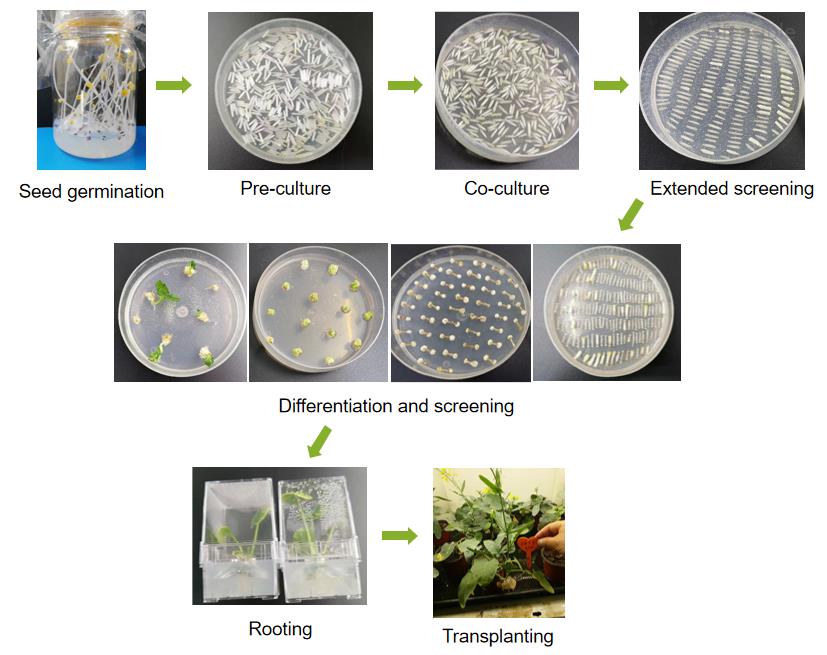
Standardized Agrobacterium-Mediated Transformation Workflow for Brassica napus L.
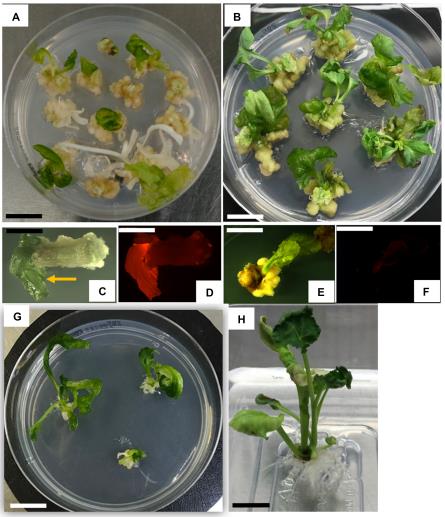
This case study illustrates the complete tissue-culture pipeline for Brassica napus L. (canola) transformation. The process begins with sterile seed germination on solid medium, followed by pre-culture of hypocotyl explants to establish competent tissue. Subsequent co-culture enables T-DNA transfer, after which extended antibiotic screening selectively eliminates non-transformed cells. Resistant calli then undergo differentiation and repeated screening to regenerate green shoots. Once shoots reach adequate size, they are transferred to rooting medium to establish a robust root system. The final stage involves acclimatization and transplanting to soil under controlled greenhouse conditions, yielding healthy T0 plantlets ready for molecular verification.
Genotype-Independent Canola Transformation via Novel Internodal Explants
Recent advancements in Brassica napus transformation demonstrate that seedling internodal segments (epicotyl and higher stem) serve as superior explants compared to conventional hypocotyls, overcoming genotype dependency in elite commercial germplasm. This optimized Agrobacterium-mediated protocol, utilizing the spcN selectable marker under spectinomycin pressure and LED light preconditioning, delivers robust transgenic events across both male and female heterotic groups. The system also enables efficient CRISPR-Cas9-mediated editing, with confirmed biallelic mutations in both A and C genome copies. The streamlined workflow produces fertile T0 plants in approximately 66 days, offering a scalable solution for canola genome engineering and commercial trait deployment.
Our commitment to precision and reliability has made Lifeasible a partner for academic and industrial researchers worldwide. Below are representative feedback from recent collaborations:
"Lifeasible delivered Westar transformants with confirmed multi-allelic edits. The genotyping report clearly distinguished A- and C-genome mutations. Turnaround was consistent with quoted timelines."
Dr. A. Peterson
Principal Scientist
USA
"We required custom protocol optimization for a winter-type breeding line. After a feasibility pilot, the team achieved positive T0 events where standard hypocotyl methods had previously failed."
Dr. L. Whitmore
Senior Lecturer
UK
"The segregation data for T1 transgene-free lines was exceptionally clean. Their molecular characterization pipeline saved us months of in-house screening."
Dr. H. Fischer
Group Leader
Germany
"Professional handling of our elite spring cultivar. The project design consultation helped us select appropriate selectable markers for our specific germplasm."
Dr. C. Laurent
Research Director
France
"Reliable delivery of edited canola lines for our fatty acid pathway study. The mutation screening by amplicon sequencing was thorough and publication-ready."
Dr. M. Rossi
Associate Professor
Italy

Allotetraploid Expertise
Deep understanding of A- and C-genome homoeologs for true functional knockouts in polyploid oilseed rape.

Genotype Adaptability
Standard protocols for Westar and Zhongshuang 11, plus custom optimization for recalcitrant commercial cultivars.

Full-Cycle Delivery
From target design to T1/T2 homozygous or transgene-free seed production.

Regulatory Awareness
DNA-free editing options and transgene segregation strategies for downstream compliance.
Are you ready to accelerate your canola research?
Our technical experts are available to discuss your project requirements, from vector design to greenhouse management. From CRISPR-based gene editing to stable transgenic line development, Lifeasible is your trusted partner for every stage of Brassica napus genetic engineering.
B. napus carries two distinct subgenomes (A and C) derived from its progenitors B. rapa and B. oleracea. Consequently, most genes exist as homoeologous pairs, meaning a functional knockout often requires simultaneous disruption of multiple copies across both subgenomes. Single-allele edits frequently fail to produce phenotypic changes due to functional redundancy, which complicates both research and breeding applications. Lifeasible addresses this fundamental challenge by designing multiplex sgRNA panels that target conserved sequences across homoeologs, coupled with high-throughput amplicon sequencing to identify rare plants carrying mutations in all relevant copies. This approach transforms what might otherwise be a routine CRISPR service into a genuine polyploid engineering solution tailored for oilseed rape. Without this capability, researchers risk spending months analyzing T0 plants that retain partial gene function, delaying trait validation and publication timelines. For a broader technical overview, see our CRISPR-Cas9 guide.
Transformation efficiency in canola varies dramatically among cultivars and market classes. While Westar remains the gold standard reference genotype for academic research, many elite spring and winter varieties exhibit marked recalcitrance to tissue culture and Agrobacterium infection. This genotype dependency represents one of the largest bottlenecks in canola genetic engineering. Lifeasible offers structured pilot feasibility studies to systematically assess callus induction rates, antibiotic sensitivity, and shoot regeneration capacity before committing to full-scale transformation. For breeder-provided germplasm, we adapt hormone regimes, explant sources, and co-cultivation conditions to maximize success, effectively bridging the critical gap between well-characterized model genotypes and the commercially relevant material that ultimately matters for agricultural application.
Obtaining a PCR-positive T0 plant is merely the beginning of a serious canola gene-editing project. Because B. napus frequently exhibits self-incompatibility or complex inheritance patterns, subsequent generations require careful crossing design and population management. Simply harvesting T0 tissue does not guarantee stable transmission of edits to progeny. Lifeasible provides comprehensive generation advancement services including controlled selfing, crossing, and genotypic selection to recover homozygous edited lines or transgene-free segregants. This full-cycle capability ensures researchers receive not merely primary transformants, but stable genetic stocks ready for rigorous phenotypic evaluation, biochemical analysis, or direct insertion into commercial plant breeding programs without further genetic manipulation.
Canola gene editing extends far beyond basic research into high-value trait development with immediate agricultural relevance. Key targets include pod shatter resistance to reduce harvest losses, modification of oil fatty acid profiles such as oleic acid or erucic acid content, herbicide tolerance for improved weed management, and quantitative enhancement of clubroot disease resistance. Lifeasible's integrated platform supports both fundamental gene-function studies and applied pre-breeding trait validation, with downstream phenotyping, hormone profiling, and biochemical analysis available to confirm agronomic impact. By connecting precise genome editing to measurable field-relevant outcomes, we help bridge the translational gap between laboratory discovery and varietal improvement, aligning with the broader context of genetic modification in agriculture.
B. napus is an allotetraploid with A and C subgenomes. Most genes have homoeologous copies, so knocking out one copy often leaves functional redundancy. True loss-of-function requires editing multiple alleles simultaneously, which demands careful sgRNA design and thorough genotyping across both subgenomes to confirm that all target copies carry disruptive mutations.
While Westar and Zhongshuang 11 are our validated reference genotypes, we routinely accept custom cultivars. We recommend a pilot feasibility study for non-standard germplasm to optimize explant preparation, hormone regimes, and selection parameters before initiating a full project. This minimizes risk and ensures compatibility with our pipeline.
T0 plants are primary regenerants from tissue culture, typically hemizygous for transgenes and potentially chimeric for edits. T1 seeds are derived from selfed or crossed T0 plants, allowing segregation analysis, zygosity confirmation, and recovery of transgene-free edited lines. T1 delivery adds 3–5 months but provides genetically stable material suitable for phenotyping.
Yes. We provide transient CRISPR/Cas9 RNP delivery and plasmid-based editing with subsequent segregation to remove transgene cassettes. DNA-free strategies are particularly valuable for regulatory-sensitive applications and breeding programs requiring non-transgenic endpoints.
We use locus-specific PCR amplification followed by Sanger sequencing, amplicon deep sequencing, or clone-based sequencing to resolve mutation patterns across homoeologous copies. This ensures we identify plants with complete knockout genotypes rather than partial edits that would fail to produce a phenotype.
We maintain vectors with Kanamycin, Hygromycin, Phosphinothricin (Basta), and G418 resistance markers. Marker choice depends on your genotype's natural tolerance and downstream breeding objectives; our team provides consultation on optimal selection strategies.
Yes. We offer comprehensive generation advancement from T0 through T2, including self-pollination, genotyping, and preliminary phenotypic screening. T2 homozygous lines eliminate segregation and provide stable material for field trials or publication.

CRISPR-Cas9: A Comprehensive Guide to Genome Editing in Plants

Understanding GMOs: A Comprehensive Guide to Genetic Modification in Agriculture

Unlocking the Basics: What is Genetic Transformation and Why It Matters
Microspore Culture and Plant Regeneration of Brassica napus
Reference
 Download
Enter Your Details for Immediate PDF Access
Get Latest Lifeasible News and Updates Directly to Your Inbox


A Supergene for Mirror-Image Flowers in Wachendorfia
July 31, 2026
Sentinel Plants Quantify Bioavailable Nitrate
July 24, 2026