Professional, Customizable Glycine max Transformation Services
Lifeasible stands at the forefront of legume biotechnology, delivering a comprehensive, high-efficiency platform for soybean transformation service. Glycine max (soybean) represents one of the most economically significant crops globally, serving as the predominant source of plant-based protein and vegetable oil while functioning as an exceptional model organism for studying nitrogen fixation, symbiotic relationships, and seed development. Our specialized services address the inherent challenges of soybean regeneration, offering academic researchers and agricultural biotechnology firms a streamlined pathway from gene concept to stable transgenic events.
Drawing upon our extensive expertise in plant transformation, we provide end-to-end support for diverse project objectives, including oil composition modification, protein quality enhancement, abiotic stress tolerance development, and nodulation efficiency improvement.
TARGET GENOTYPES
Williams 82, etc.
Standard cultivars & elite lines
TYPICAL YIELD
8-25
Independent T0 Positive Soybean Events
EDITING EFFICIENCY
Up to 75%
High-efficiency gene editing
LEAD TIME
5-7 Months
From vector receipt to T1 seeds
Standard Package
Efficiency Focused
Premium Package
Full-Service Custody
Stable transformation constitutes the foundation of modern soybean improvement, enabling permanent integration and heritable expression of novel genetic traits. At Lifeasible, we have refined both Agrobacterium-mediated transformation and biolistic approaches to ensure reliable T-DNA integration with optimized copy number profiles.
While Agrobacterium-mediated methods utilizing cotyledonary node explants remain our primary approach due to efficiency and manageable integration patterns, we also offer particle bombardment for specialized applications such as plastid genome engineering or delivery of large DNA constructs exceeding conventional T-DNA capacity limitations.

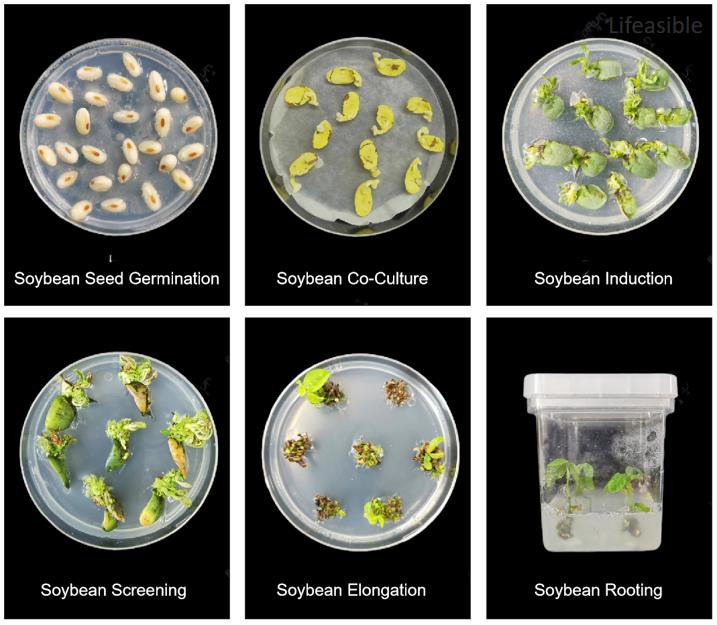
Explant Selection & Preparation
Surface-sterilized mature seeds or immature cotyledons establish responsive target tissues.

Infection & Co-cultivation
Agrobacterium inoculation with acetosyringone boosts virulence and T-DNA transfer.

Stringent Selection
Multi-phase antibiotics eliminate non-transgenic tissues while preserving meristem viability.

Shoot Organogenesis
Hormone-optimized shoot induction bypasses callus, minimizing somaclonal variation.

Acclimatization & Hardening
Controlled greenhouse hardening ensures high T0 plantlet survival with robust roots.
For projects demanding rapid data acquisition, Lifeasible offers high-throughput transient expression systems that circumvent lengthy regeneration cycles. These assays enable functional validation of gene constructs, promoter strength evaluation, and protein subcellular localization within days rather than months, providing critical preliminary data before committing to stable transformation.

Vector Design & Preparation
Selection of optimized transient expression vectors and high-purity plasmid preparation for soybean-compatible systems.

Target Material Isolation
Preparation of viable soybean protoplasts from etiolated hypocotyls or healthy leaf tissues for transformation assays.

DNA Delivery
Application of PEG-mediated transfection or protoplast regeneration techniques for efficient DNA uptake.

Incubation & Analysis
Controlled cultivation followed by fluorescence imaging, qPCR, or Western blotting for quantitative assessment.
Lifeasible employs a diverse, optimized toolkit to address the challenges inherent to legume genetic engineering. We offer multiple transformation methodologies to ensure successful DNA delivery into Glycine max tissues, accommodating both stable integration and transient functional analysis requirements.

This represents our primary method for generating stable transgenic soybean lines. We utilize optimized Agrobacterium tumefaciens strains with virulence-enhancing compounds to infect cotyledonary node explants. This approach is preferred for producing transgenic plants with low copy numbers and stable inheritance, particularly when coupled with direct shoot organogenesis protocols that bypass callus formation.
For specific applications including plastid transformation or delivery of large constructs, we employ biolistic delivery. This physical method utilizes high-velocity gold particles coated with DNA to penetrate cell walls, delivering genetic material directly to nuclei or chloroplasts. This approach proves valuable for recalcitrant genotypes or when Agrobacterium susceptibility is limited.
PEG-mediated transfection of isolated soybean protoplasts serves as an ideal platform for high-throughput validation of CRISPR/Cas9 constructs, rapid assessment of gene function, and preliminary evaluation of expression vectors before stable transformation commitment.
For specific research objectives, we offer in planta transformation approaches targeting meristematic tissues, enabling direct production of transgenic seeds without extensive tissue culture intervention.
| Category | Requirements |
| Sample Type | Mature seeds, immature pods, or sterile plantlets of your soybean cultivar |
| Sample Amount | Minimum 200 g of healthy, mature seeds (approximately 400–500 seeds) |
| Pre-Treatment | Seeds must be clean, free from fungal contamination, and not chemically treated; detailed cultivar information required |
| Storage Conditions | Store seeds at 4°C in dry conditions; avoid prolonged storage (>12 months) |
| Shipping | Ship at ambient temperature with appropriate moisture control; include desiccant packets |
| Metadata Needed | Cultivar name, maturity group, generation/purity, known transformation recalcitrance, target gene/construct details, preferred selection markers |
| Vector Information | Complete plasmid construct map including promoter, gene of interest, selection marker, and reporter genes |
Complement your core transformation projects with our specialized downstream validation and precision engineering solutions:
Molecular Characterization & Transgene Validation
We provide comprehensive analysis confirming successful integration and expression, including Southern Blotting for copy number determination, RT-qPCR for transcript quantification, and Northern Blot analysis.
CRISPR/Cas9 Off-Target Screening
To ensure editing precision, we utilize advanced NGS-based sequencing to identify and analyze potential off-target effects across the soybean genome.
Custom Vector Design & Construction
Our team engineers complex T-DNA vectors including multi-gene stacking, seed-specific promoters, and codon optimization tailored for Glycine max.
Subcellular Localization & Imaging
Visualize target proteins using fluorescent tagging (GFP/YFP/RFP) and high-resolution confocal microscopy to determine precise protein distribution within soybean cells.
Phenotypic Stress Tolerance Assays
Evaluate functional impacts of genetic modifications through controlled screening for resistance to drought, salinity, or pathogen challenge.
Multi-Omics Integration
Combine transcriptomics, proteomics, and metabolomics for comprehensive characterization of transgenic lines.

Strategy & Vector Construction

Explant Preparation

Transformation & Selection

Regeneration & Hardening

Molecular Characterization

Seed Harvest
Note: Timelines may vary depending on genotype, transformation method, and the complexity of genetic modification.
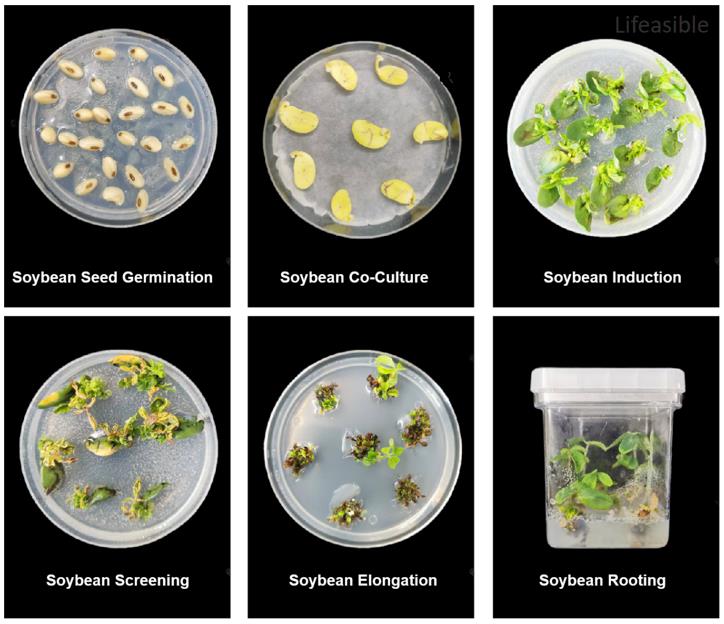
Stable Expression in Soybean
Internal project data confirming reliable transgenic line generation using our optimized cotyledonary node protocol. This ensures efficient transformation with direct shoot organogenesis, bypassing callus formation to minimize somaclonal variation and accelerate recovery of fertile plants.
CRISPR/Cas9 Dual-Gene Knockout in Soybean
Internal project data confirming efficient multiplexed gene editing using our optimized cotyledonary node transformation protocol. This ensures precise dual-target knockout with high positive detection rates and stable transgene inheritance.
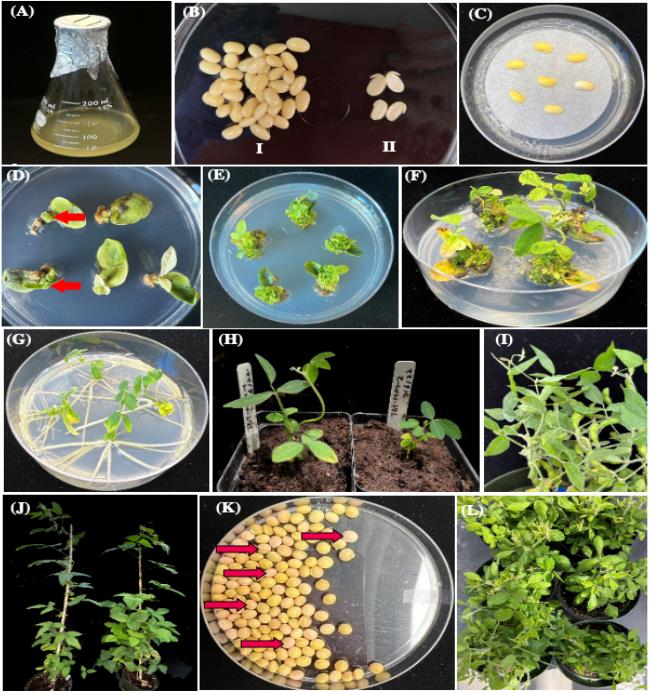
Agrobacterium-Mediated Transformation of the Dwarf Soybean MiniMax
This study establishes an efficient Agrobacterium-mediated transformation system for the 'MiniMax' soybean cultivar, a compact, early-maturing variety with a ~90-day growth cycle ideal for rapid gene validation. The protocol employs a modified 'half seed' regeneration method incorporating phloroglucinol (PG) to dramatically improve rooting efficiency from 25% to 84%, combined with an organic soil amendment containing mycorrhiza to ensure robust greenhouse establishment. Using the GAANTRY system with spectinomycin selection and mCherry3 reporter visualization, the workflow delivers heritable T1 transgenic seeds in approximately 145 days with a lab-to-greenhouse production efficiency of 4.0%.
Our dedication to precision and reliability has established Lifeasible as a trusted partner for academic and industrial researchers worldwide. Below is representative feedback from recent collaborations:
"Lifeasible's Agrobacterium-mediated protocol for our elite Williams 82 lines yielded 18 independent T0 events, with 9 confirmed single-copy integrations via Southern blot. While we observed slight phenotypic variation in three lines likely attributable to tissue culture effects, the overall efficiency allowed us to advance our high-oleic acid phenotyping six months ahead of schedule. The technical team's responsiveness to our specific promoter requirements was exceptional."
Dr. E. Whitfield
Principal Investigator
USA
"We commissioned hairy root transformations for 18 nodulation receptor constructs. The 5-week turnaround allowed us to complete a full symbiosis screen before the growing season. Two constructs showed unexpected infection thread phenotypes that redirected our entire CRISPR knockout strategy for stable lines. Essential service for legume symbiosis labs."
Dr. F. Lindemann
Group Leader
Germany
"We've commissioned 4 soybean transformation projects with Lifeasible since 2022. Their Southern blot characterization consistently meets publication standards, though we recommend budgeting additional time for T2 homozygous line selection—our experience averaged 16 months from vector submission to fixed lines. The documentation quality supports direct journal submission without additional formatting."
Dr. S. Brennan
Associate Professor
USA
"Our proprietary high-protein variety failed standard Agrobacterium protocols at three other service providers. Lifeasible developed a modified biolistic approach over four months, ultimately generating 8 positive T0 lines. The extended R&D phase required cost negotiation, but their transparency regarding genotype-specific limitations and troubleshooting steps was commendable. Final lines are currently in field trials."
Dr. M. Ricci
Senior Scientist
Italy
"For routine Jack variety CRISPR knockouts, Lifeasible offers competitive pricing and reliable PCR genotyping. We typically receive 12-18 T0 plants per construct, with editing efficiency around 65% in our experience—consistent with their projections. Highly recommended for labs lacking in-house legume tissue culture infrastructure."
Dr. R. Patterson
Assistant Professor
USA

Legume-Specific Expertise
Decades of specialized experience in Glycine max transformation, ensuring deep technical knowledge of soybean tissue culture, regeneration requirements, and genotype-specific optimizations.

Genotype Versatility
Proven success transforming diverse soybean germplasm, from standard model cultivars like Williams 82 and Jack to recalcitrant elite commercial varieties with specific growth habits.

Technical Precision
Industry-leading editing efficiency utilizing advanced prime editing, base editing, and CRISPR/Cas9 technologies optimized for the soybean genome.

Global Compliance
All soybean engineering projects conducted in state-of-the-art facilities adhering to strict international biosafety regulations and phytosanitary standards.
Are you ready to accelerate your soybean research?
Our technical experts are available to discuss your project requirements, from vector design to greenhouse management. From gene editing to stable transgenic line development, Lifeasible is your trusted partner for every stage of soybean genetic engineering.
Glycine max (soybean) represents not only a cornerstone of global agriculture but also the premier model organism for legume research.
Glycine max occupies a unique position in plant biotechnology: an economically indispensable crop with biological complexities that resist one-size-fits-all approaches.
Soybean transformation has progressed substantially from early low-efficiency, genotype-limited methods to highly optimized, broadly applicable systems. Initial approaches relied heavily on particle bombardment of embryogenic cultures, which frequently produced complex integration patterns. The refinement of Agrobacterium-mediated cotyledonary node transformation marked a watershed moment, enabling more predictable gene transfer with reduced copy numbers. Contemporary advances including CRISPR/Cas-mediated genome editing, RNAi silencing, and tissue culture-free transformation strategies continue expanding capabilities, permitting faster, more accurate genetic modifications.
Agrobacterium-mediated transformation utilizing cotyledonary node explants has emerged as the gold standard for soybean genetic engineering due to its efficiency, reliability, and favorable integration patterns. This method exploits the natural T-DNA transfer capability of Agrobacterium tumefaciens while leveraging soybean's robust capacity for direct shoot organogenesis from meristematic tissues. Bypassing callus formation through direct organogenesis minimizes somaclonal variation and accelerates recovery of fertile plants. Optimized infection conditions, strain selection, and co-cultivation protocols have further improved transformation efficiency across diverse germplasm, making this approach highly reliable for both functional genomics and trait development in soybean improvement programs.
Standard cultivars including Williams 82, Jack, Maverick, and Forrest demonstrate the highest transformation efficiency and serve as our recommended starting points for new projects. These varieties exhibit excellent regeneration capacity through cotyledonary node organogenesis and consistent responses to Agrobacterium-mediated transformation. However, we have successfully adapted protocols for numerous elite and specialty varieties, including high-protein lines, low-linolenic acid types, and dwarf cultivars such as MiniMax. For proprietary or uncharacterized germplasm, we recommend initiating with a pilot feasibility study (50-seed batch) to assess transformation competence and optimize protocol parameters before committing to full-scale production.
We provide comprehensive detection of transgenic plant services ensuring data integrity through multiple verification tiers. Initial screening employs PCR-based detection of transgene-specific sequences in leaf tissue sampled from rooted plantlets. Positive candidates advance to Southern blot analysis for copy number determination and integration pattern assessment, critical for identifying single-copy events preferred for commercial applications. For gene editing projects, we offer targeted amplicon sequencing to characterize mutation profiles and confirm intended modifications. Expression validation through RT-qPCR, Northern blot, or Western blotting provides quantitative assessment of transcript and protein accumulation. All data are compiled into comprehensive reports suitable for regulatory submission or peer-reviewed publication.
Our standard workflow delivers T0 plantlets in 5-6 months and T1 seeds in 8-10 months from vector receipt, though timelines vary with genotype and seasonality. For standard varieties like Williams 82 or Jack under optimized greenhouse conditions, accelerated protocols can generate soil-ready T0 plants in 12-14 weeks. Elite varieties and complex editing projects may require 2-3 additional months due to extended regeneration phases or lower transformation efficiency. The T1 seed production phase (12-16 weeks) encompasses flowering, pod development, and seed maturation, with duration influenced by photoperiod sensitivity and maturity group classification. We provide quarterly progress updates and can accommodate rush scheduling for time-sensitive research objectives such as grant deadlines or field season planting windows.
Elite soybean varieties—those with optimized agronomic performance, disease resistance, or specialty end-use quality—often exhibit pronounced transformation recalcitrance compared to model lines like Williams 82. This genotype specificity stems from multiple interacting factors: differences in cell wall composition affecting Agrobacterium attachment, varying antioxidant capacity influencing browning severity, distinct hormone sensitivity profiles impacting shoot organogenesis, and potentially altered meristem architecture affecting wounding response. Unlike standard lines where protocols are highly optimized, each elite variety requires systematic adaptation of wounding intensity (micro-brush pressure, sonication duration, or vacuum level), co-cultivation antioxidant composition, and hormone concentrations in selection media.
Yes, though with modified expectations and potential protocol adaptation. Elite soybean varieties often exhibit reduced Agrobacterium susceptibility, variable callus/organogenesis responses, or stringent tissue culture requirements that complicate standard protocols. We recommend initiating with pilot feasibility studies (100-seed batch) to assess transformation competence and identify genotype-specific limitations before full-scale commitment. Our experience includes successful transformation of high-protein, specialty oil, and dwarf varieties through systematic optimization of wounding intensity, co-cultivation conditions, and hormone regimes. Transparent reporting of genotype-specific challenges and realistic projections of success rates ensures informed decision-making. For extremely recalcitrant material, alternative approaches such as biolistic delivery or protoplast transformation may be recommended.

Construction of Soybean NAC Cloning Vector

Detection of Genetic Diversity of Rice Parents by RFLP

Transformation of Tomato

Understanding GMOs: A Comprehensive Guide to Genetic Modification in Agriculture
Reference
 Download
Enter Your Details for Immediate PDF Access
Get Latest Lifeasible News and Updates Directly to Your Inbox


A Supergene for Mirror-Image Flowers in Wachendorfia
July 31, 2026
Sentinel Plants Quantify Bioavailable Nitrate
July 24, 2026