Professional, Customizable Grapevine Transformation and Genome Editing Solutions
Vitis vinifera L. (grapevine) ranks among the world's most valuable fruit crops, supplying table grapes, raisins, and wine. Its highly heterozygous genome, clonal propagation, and woody perennial growth make grapevine a demanding transformation target — but also a uniquely rewarding one for researchers who need validated, cultivar-adapted pipelines.
Building on our expertise in plant genetic transformation, we guide each project from construct design through somatic embryogenesis to verified T0 plantlets. Whether the goal is stable overexpression, targeted knockout, multiplex editing, or a DNA-free strategy, our team applies cultivar-specific optimization and transparent quality control at every stage.
TARGET GENOTYPES
Thompson Seedless
Routine in Thompson Seedless; other cultivars by feasibility review.
TYPICAL YIELD
5+
Independent PCR-positive T0 events per construct.
EDITING EFFICIENCY
Target-Optimized
Cas9 and sgRNA design tailored per target and cultivar.
LEAD TIME
9–12 Months
From vector receipt to verified T0 plantlets; varies by cultivar.
Stable Transformation Package
Transgene Integration Focused
CRISPR Knockout & Advanced Editing Package
Full-Service Genome Editing
Stable transformation is the cornerstone of grapevine genetic improvement, enabling permanent integration or targeted modification of the genome in a crop where conventional breeding is slow and outcomes uncertain. Our grapevine pipeline is organized around the biology of the species itself: embryogenic callus as the transformation receptor, somatic embryogenesis as the regeneration engine, and staged molecular verification to protect project integrity. Drawing on deep plant tissue culture expertise across woody species, the workflow converts a single engineered cell line into hardened, documented T0 plantlets.
Embryogenic Culture Initiation
Embryogenic callus established from suitable explant sources of the selected cultivar.
Infection & Co-cultivation
Acetosyringone-enhanced Agrobacterium inoculation of embryogenic cell clusters.
Antibiotic Selection
Gradual selection enriches uniformly transformed, embryo-competent cell lines.
Somatic Embryogenesis & Germination
Selected lines mature through somatic embryo development into plantlets.
Acclimatization
Regenerated plantlets hardened to soil under controlled greenhouse conditions.
Grapevine regeneration is measured in months, so an early, low-cost decision point is essential. Lifeasible's transient validation platform uses grapevine protoplasts and rapid expression assays to test constructs, promoters, and sgRNA cutting activity in days. Results de-risk the long stable pipeline and, for suitable cultivars, open the door to DNA-free genome editing strategies in which no foreign DNA is integrated.
Construct & Reagent Preparation
Vectors, sgRNAs, and RNP reagents prepared and quality-checked before delivery.
Protoplast Isolation
High-viability protoplasts isolated from young grapevine leaf tissue.
Delivery
PEG-based transfection introduces plasmid or RNP cargo efficiently.
Incubation & Readout
Fluorescence, PCR, and sequencing assays quantify editing or expression outcomes.
Lifeasible applies a delivery toolkit matched to grapevine tissue-culture realities, selecting the route according to cultivar behavior, construct type, and project objectives.
Our primary route for stable grapevine lines. We deploy optimized strains — GV3101, AGL-1, EHA101, EHA105, and C58C1 — paired with selectable markers including kanamycin, hygromycin, phosphinothricin, and G418, chosen to suit each cultivar's tolerance profile. Agrobacterium delivery remains preferred for its clean integration patterns and stable inheritance.
Isolated grapevine protoplasts are transfected by PEG-mediated delivery of plasmid or RNP reagents. Where multiplexing or distinct PAM requirements favor alternative nucleases, CRISPR/Cas12a can be substituted. This is the platform of choice for transgene-free strategies, subject to cultivar regeneration competence.
Biolistic delivery penetrates cell walls directly, offering a robust alternative for cultivars or constructs that respond poorly to Agrobacterium. It accommodates large or complex transformation cassettes without host-range constraints.
Viral vectors enable rapid loss-of-function assessment through virus-induced gene silencing (VIGS) in grapevine tissues, letting researchers preview phenotypes without waiting through stable transformation.
| Category | Requirements |
| Sample Type | Dormant, one-year-old canes or cuttings of the specified cultivar; alternatively, established embryogenic callus lines or pre-built vectors / Agrobacterium cultures |
| Sample Amount | 10–15 healthy cuttings (20–30 cm each) bearing at least 5 viable buds; established cultures should be actively growing and contamination-free |
| Pre-Treatment | Source vines must be true-to-type, pest- and disease-free, and documented with cultivar/clone identity; no chemical residue treatments |
| Storage Conditions | Keep cuttings cool (2–4 °C), wrapped to retain moisture; avoid freezing or desiccation; use within 4 weeks |
| Shipping | Fresh cuttings shipped with cold packs and moisture retention; plasmids, E. coli, and Agrobacterium shipped on dry ice to prevent degradation and loss of viability |
| Metadata Needed | Cultivar and clone name, origin, ploidy if known, vine age and health status, target gene/construct details, preferred selectable marker, prior transformation history |
| Vector Information | Customer-supplied plasmids at 80–100 ng/μL, ≥10 μL, free of degradation and contamination; Agrobacterium accepted as glycerol stocks (up to one year old) or freshly activated plates (within one week) |
Extend your grapevine transformation project with targeted downstream capabilities that connect editing, verification, and phenotype:
Multiplex Editing Strategy and sgRNA Design
Multiplex sgRNA panels targeting single or multiple loci are designed, prescreened in protoplast assays, and refined before stable grapevine delivery begins.
Transgene-Free Edited Line Development
We support segregation-based removal of CRISPR cassettes across successive generations, with molecular confirmation of cassette-free plants that carry only the intended edit.
Copy Number and Integration Site Analysis
Comprehensive copy number analysis by Southern blot and junction-fragment sequencing reveals T-DNA insertion architecture in recovered transgenic and edited grapevine lines.
Off-Target Survey and Allele Characterization
Amplicon-based sequencing of candidate off-target regions across the genome, paired with detailed monoallelic, biallelic, or homozygous classification of every recovered editing event.
Greenhouse Phenotypic Validation
Controlled-environment screening of edited vines for disease response, berry chemistry, and abiotic stress performance, with seasonal data collection across the growing cycle.
Project Design & Vector Construction
Embryogenic Material Establishment
Transformation & Antibiotic Selection
Somatic Embryogenesis & Regeneration
Hardening & Molecular Screening
Reporting & Delivery
Note: Timelines are indicative and may vary with cultivar regeneration behavior, seasonal culture conditions, and project complexity.

Non-Chimeric, DNA-Free Grapevine Genome Editing via Protoplast Regeneration
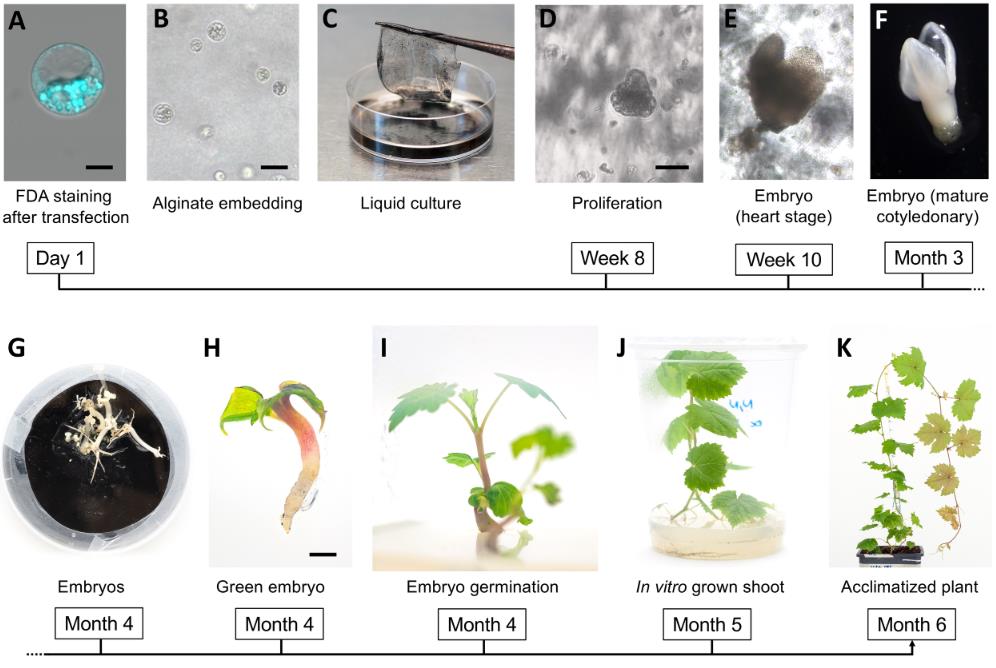
This study establishes a single-cell, DNA-free genome editing workflow in Vitis vinifera, delivering edited grapevines without stable integration of foreign DNA. Protoplasts isolated from embryogenic callus of the table grape cultivars Crimson Seedless and Sugraone were transfected by PEG-mediated delivery of pre-assembled Cas9–sgRNA RNPs targeting the downy- and powdery-mildew susceptibility genes VviDMR6 and VviMLO6. Edited protoplasts regenerated into whole plants through alginate-disc culture within roughly six months. Across 96 screened regenerants, homozygous, biallelic, monoallelic, and duplex-edited events were recovered, and single-cell origin largely eliminated chimerism — demonstrating a practical route to transgene-free improvement of elite cultivars.
Our commitment to precision and reliability has made Lifeasible a partner for academic and industrial researchers worldwide. Below are representative feedback from recent collaborations:
"The team's command of grapevine regeneration biology stood out immediately. They set realistic expectations at the start, kept us informed at every stage, and delivered documentation detailed enough to support our downstream breeding decisions without further clarification."
Dr. M. Whitaker
Associate Professor of Viticulture
USA
"From scoping call to final delivery, everything was straightforward. The team translated a complex regeneration workflow into a clear schedule with defined decision points, and our questions were answered by scientists rather than account managers."
Dr. R. Calloway
Senior Scientist
USA
"Working with a woody perennial demands honesty about timelines, and this team provided it. Their early feasibility assessment steered us away from an unsuitable cultivar, and every molecular report arrived clear, complete, and ready for internal review without rework."
Dr. J. Pemberton
Senior Research Fellow
UK
"What impressed us most was their willingness to explain the reasoning behind every culture decision. We always knew where our material stood in the pipeline, and the final handover documentation met the same standards we apply to our own published research."
Dr. A. Vogel
Group Leader, Grapevine Research
Germany
"Their screening of edited material is genuinely rigorous. We received clearly annotated genotyping results with allele-level detail, and their advice for subsequent generations reflected a real understanding of grapevine genetics rather than a generic laboratory protocol."
Dr. C. Moreau
Research Director
France
"Communication was prompt and technically substantive from the first consultation. Risks were flagged early, practical alternatives were proposed whenever regeneration lagged, and complete traceability of our starting material was maintained throughout the engagement."
Dr. F. Ricci
Principal Investigator
Italy
Grapevine-Specific Regeneration Capability
Deep command of embryogenic culture, somatic embryogenesis, and genotype-dependent regeneration — the true bottlenecks of woody vine transformation.
Transparent Cultivar Strategy
Thompson Seedless handled routinely; every other cultivar scoped through honest feasibility assessment rather than overpromising.
Editing Quality Control
Early-stage selection, allele-level sequencing, and chimerism management deliver interpretable, publication-grade molecular data.
Complete Traceability and Compliance
Full chain-of-custody documentation from starting material to delivered plantlets, aligned with international biosafety expectations.
Ready to move your grapevine research forward?
Our technical specialists are available to discuss cultivar selection, construct design, and project timelines — from first feasibility review through delivery of verified T0 plantlets. Whether you need stable transformation, targeted knockout, or a DNA-free editing strategy, Lifeasible is prepared to support every stage of your Vitis vinifera project.
Grapevine is a woody perennial vine with a highly heterozygous genome, clonal propagation, and a long juvenile phase — a biological profile that separates it sharply from annual model plants. In Arabidopsis or tobacco, transformation and regeneration can be completed in weeks; in grapevine, the limiting step is not DNA delivery but the recovery of whole plants from transformed cells. Embryogenic competence varies widely among cultivars, somatic embryos mature slowly, and the journey from a selected cell line to a rooted plantlet routinely spans many months. Chimerism adds a further complication: a shoot that tests positive may still carry non-edited sectors, so early-stage selection and allele-level verification are essential. These constraints explain why grapevine transformation remains a specialized, long-cycle service — and why cultivar-specific protocols and rigorous quality control separate credible providers from generic ones.
Vitis vinifera is among the oldest and most economically important fruit crops, contributing table grapes, raisins, wine, and grape-derived products worldwide. The berries accumulate 10–30% sugar, predominantly glucose, alongside organic acids that shape flavor, and are notable sources of minerals, B vitamins, vitamin C, vitamin P, and essential amino acids. Beyond the fruit, grapevine roots and vines have a long history of traditional medicinal use. Yet improvement through conventional breeding is slow: crosses between heterozygous parents yield highly variable offspring, and evaluating a new cultivar takes well over a decade. Transformation and genome editing compensate for these disadvantages, enabling targeted changes in fruit quality, disease resistance, and stress tolerance while preserving the genetic identity that defines a valued cultivar.
A grapevine editing project is, at its core, a campaign to rescue one desirable cell from millions and prove precisely what happened to it. The pipeline begins with embryogenic callus — proliferating cells capable of forming somatic embryos — which is infected with Agrobacterium carrying the construct or editing machinery. Antibiotic selection enriches transformed cells, but selection alone cannot guarantee uniformity, so early-stage checks favor homogeneous cell lines before embryos are induced. Somatic embryos then mature, germinate, and convert into plantlets that are hardened in the greenhouse. Only then does full molecular characterization begin: PCR confirms integration, target-site sequencing identifies mutations, and alleles are classified as monoallelic, biallelic, or homozygous. Each plantlet is tracked as an independent event, giving researchers genuine biological replicates rather than clones of a single integration.
Because elite grapevine cultivars are heterozygous and propagated clonally, many breeding programs want the edit without the editing machinery. Retaining a CRISPR cassette complicates deregulation and consumer acceptance, and segregation — the usual route to transgene-free material in seed crops — is slow in a vine that takes years to flower. Research pipelines are therefore moving toward DNA-free delivery: purified Cas9 protein complexed with guide RNAs (RNPs), or transiently expressed editors introduced into protoplasts, with edited cells subsequently regenerated into whole plants. This approach has been demonstrated in grapevine but remains dependent on cultivar-specific regeneration competence, so availability must be assessed case by case. We evaluate each project for the most appropriate route, combining honest feasibility review with both plasmid-based and DNA-free strategies.

Thompson Seedless is our established reference genotype, with a routinely validated pipeline from embryogenic culture through T0 delivery. Other V. vinifera cultivars — including wine grapes such as Chardonnay, Cabernet Sauvignon, Merlot, and Syrah — are admitted through a structured feasibility assessment that evaluates embryogenic response, selection sensitivity, and regeneration capacity before full-scale work begins. We deliberately avoid guaranteeing outcomes for cultivars we have not tested internally; where a cultivar proves recalcitrant, we report this early and propose alternatives, including closely related responsive genotypes as pilot backgrounds.
The timeline is driven by regeneration biology rather than DNA delivery. Establishing competent embryogenic callus, applying stepwise antibiotic selection, and maturing somatic embryos into germinable, plantlet-forming stages are intrinsically slow processes in a woody perennial. Competing platforms quote comparable durations — roughly ten months is typical across the field. We publish stage-level timelines so you can plan publications, funding milestones, and downstream experiments realistically, and we flag cultivars or construct types that historically extend the schedule.
Every candidate plantlet is screened by PCR and target-site sequencing, with amplicons cloned or deep-sequenced as needed to resolve allele composition. Events are classified as monoallelic, biallelic, or homozygous, and heterogeneous or chimeric patterns are explicitly flagged in the report rather than averaged away. Upstream, early-stage selection is used to enrich uniformly transformed cell lines before somatic embryos are induced, which reduces — though cannot always eliminate — chimerism. Only plants with interpretable, well-documented genotypes are advanced to delivery.
Two routes exist. The first is segregation: edited T0 plants are grown to flowering, and progeny or clonal derivatives that retain only the mutation — not the CRISPR cassette — are identified molecularly; this is slow in grapevine given its juvenility. The second is DNA-free delivery, in which RNP or transient editor systems are introduced into protoplasts and regenerated plants never integrate foreign DNA. Availability of the DNA-free route depends on cultivar regeneration competence and is assessed during feasibility review. We recommend the route case by case and never present transgene-free delivery as guaranteed.
Customers may submit constructed plasmids (80–100 ng/μL, ≥10 μL, free of degradation and contamination), Agrobacterium cultures as glycerol stocks up to one year old or as plates activated within one week, or starting plant material such as dormant cuttings of a specified cultivar. Plasmids, E. coli, and Agrobacterium must be cryopreserved and shipped on dry ice to protect viability. Strains, vectors, and receptor materials used in a project are stored free of charge for six months, and can be retrieved at any time.
Our standard marker set covers kanamycin, hygromycin, phosphinothricin, and G418, selected according to each cultivar's natural tolerance. On the delivery side, we maintain GV3101, AGL-1, EHA101, EHA105, and C58C1, choosing the strain best matched to the cultivar and construct. Custom markers and less common strains can be accommodated after discussion with our project team.
Yes. Our pipeline addresses V. vinifera cultivars across table, raisin, and wine categories, and we evaluate rootstocks and American Vitis species case by case. Because cultivar behavior differs substantially, all non-standard materials pass through the feasibility assessment described above, which protects both the timeline and your budget before a full project is committed.

CRISPR-Cas9: A Comprehensive Guide to Genome Editing in Plants

Unlocking the Potential of CRISPR-Cas12a in Plant Genome Editing

The Power of Molecular Breeding in Crop Improvement

Understanding GMOs: A Comprehensive Guide to Genetic Modification in Agriculture
Reference