A Protein Repair Enzyme Bolsters Rice Sheath Blight Resistance
Introduction
Sheath blight is among the most damaging fungal diseases of rice. The culprit is the soil-borne necrotrophic fungus Rhizoctonia solani, which infects rice sheaths and can cause substantial crop losses. Improving genetic tolerance to sheath blight remains a challenge for rice breeding. A 2026 study identifies a protein repair enzyme that helps maintain defense protein activity during infection. The findings add protein maintenance to the mechanisms worth investigating in rice disease research.
At the heart of the finding is PROTEIN L-ISOASPARTYL METHYLTRANSFERASE, commonly abbreviated as PIMT. PIMT has established roles in seed longevity and abiotic stress tolerance, but its contribution to plant responses to pathogens remained unclear. The new work demonstrates that, in rice, PIMT not only operates during infection but actively strengthens the plant's ability to withstand sheath blight. The results provide a basis for testing protein repair as a target in crop improvement.
The Hidden Damage of Isoaspartyl Modification
Proteins are not static molecules. Over time, and especially under stress or during pathogen attack, their amino acid backbones can spontaneously rearrange. One particularly troublesome change is the formation of isoaspartyl (isoAsp) residues, which can alter the protein backbone and impair protein function.
PIMT participates in protein repair. The enzyme recognizes isoAsp-damaged sites and methylates them, initiating a repair cycle that can restore normal aspartyl linkages. In seeds and under abiotic stress, this cleanup preserves protein activity and protects cellular health. What the new research reveals is that the same repair system becomes critically important when a pathogen like Rhizoctonia solani attacks, because infection itself appears to drive isoAsp formation in key defense proteins. PIMT-deficient plants accumulated more isoAsp damage and showed greater susceptibility, linking protein repair with disease tolerance.
Engineering Rice to Test PIMT's Role
The authors used three complementary genetic approaches to test PIMT function in rice. First, they evaluated previously generated lines with increased OsPIMT1 or OsPIMT2 expression through gene overexpression in plants, and assessed their response to infection. Second, they used RNA interference to suppress PIMT expression, targeting both OsPIMT1 and OsPIMT2. Third, they applied CRISPR/Cas9 plant genetic modification to disrupt OsPIMT1 or OsPIMT2 and characterize the resulting mutants.
This three-pronged strategy is powerful because it tests the same question from opposite directions. If PIMT truly matters for resistance, then overexpression should protect plants while suppression and knockout should leave them vulnerable. Overexpression reduced disease symptoms, while RNAi and genome-edited lines showed increased susceptibility, with stronger effects in pimt1 than in pimt2. These complementary approaches provide a useful experimental framework for plant genetic engineering programs targeting other crops and pathogens.
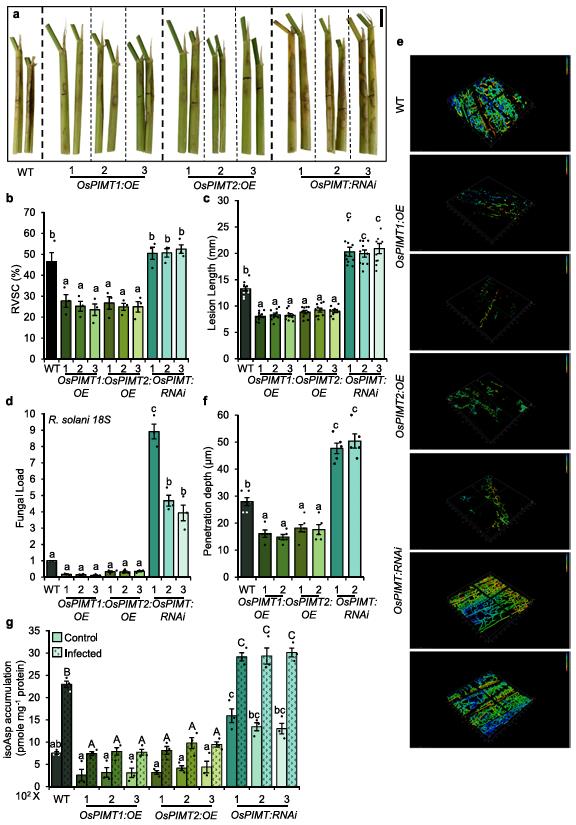
Figure 1. OsPIMT overexpression enhances sheath blight tolerance and restricts fungal penetration in rice, compared with wild-type and RNAi lines. (Gautam, et al., 2026)
PIMT Restricts Fungal Penetration
The engineered rice lines differed in their response to Rhizoctonia solani. Overexpressing plants showed markedly smaller lesions and slower disease progression, while PIMT-deficient plants developed more severe disease symptoms. Microscopic examination showed reduced fungal penetration and colonization in the overexpression lines.
In susceptible lines, fungal hyphae penetrated more deeply and formed denser mycelial structures. In the PIMT-overexpressing plants, fungal penetration and colonization were reduced. These observations support a protective role for PIMT during infection. For researchers tracking field outbreaks, reliable plant disease identification remains essential to confirm which lesions are truly sheath blight and not a look-alike disorder.
A Repair Network of Resistance Proteins
The next question was mechanistic: which proteins does PIMT actually protect during infection? Using co-immunoprecipitation followed by liquid chromatography–tandem mass spectrometry, the team identified candidate PIMT-associated proteins in infected tissue. The candidates included antioxidant proteins, OsALDH7, referred to as OsALDH in the study, and the pathogenesis-related protein OsPBZ1/OsPR10a.
Selected proteins, including OsALDH and OsPBZ1, showed evidence of infection-associated damage, and follow-up biochemical assays measured isoAsp accumulation. Follow-up assays validated interactions and PIMT-dependent functional recovery for OsALDH and OsPBZ1. The results identify specific defense-associated proteins whose activity can be maintained through PIMT-mediated repair. For laboratories designing validation experiments, complementary gene function analysis can help test how individual candidates contribute to disease responses.
Restoring Antifungal Activity Through Repair
The study went further than mapping interactions. It tested whether the repaired proteins actually fight the fungus. Both OsALDH and OsPBZ1 possess intrinsic antifungal activity on their own, capable of suppressing fungal growth in controlled assays. However, when these proteins carried isoAsp lesions, that activity was impaired. Once PIMT repaired the damage, the antifungal potency returned.
These assays distinguish protein abundance from the functional state of defense-associated proteins. A plant may produce plenty of ALDH and PBZ1, yet still fall ill if those proteins are structurally corrupted by isoAsp formation. PIMT-mediated repair restored the activity of the damaged proteins in the tested assays. Alongside mechanistic studies, accurate plant pathogen detection helps time interventions; the study did not establish the durability of protection under field conditions.
ROS Homeostasis and Lipid Protection
Beyond direct antifungal effects, the work uncovered a second layer of protection centered on cellular balance. OsALDH overexpression reduced reactive oxygen species (ROS), lipid peroxidation markers, and host cell death during infection. Separate fungal assays showed that active OsALDH reduced ROS accumulation in fungal hyphae and was associated with inhibited growth.
By repairing ALDH, PIMT helps the plant maintain ROS homeostasis, cushioning membrane damage and preserving cell integrity. In the fungus, the authors instead propose that OsALDH disrupts the ROS balance needed for normal growth; the precise antifungal mechanism remains unresolved. PIMT itself did not directly inhibit fungal growth in the reported assay; its protective role involves maintaining the function of proteins such as OsALDH and OsPBZ1.
Implications for Crop Protection
Sheath blight is notoriously difficult to breed against because natural resistance is partial and quantitative. The PIMT story suggests a complementary strategy: instead of only searching for new resistance genes, we might enhance the cellular maintenance systems that keep existing defenses working. A plant with robust protein-repair capacity could preserve the function of many resistance proteins at once, an idea that requires testing across pathogens and field conditions.
This principle could extend to other crops plagued by necrotrophic fungi. If isoAsp-mediated damage is a common feature of infection, then boosting PIMT-like repair enzymes may be a broadly useful lever. It also highlights a new target space for biotechnology: not just the sensors and signaling nodes of immunity, but the quality-control machinery that sustains them. Testing these approaches in additional crops and pathogens would help establish their scope; fungicide reduction and yield stability were not evaluated here.
Conclusion
The study identifies protein repair by rice PIMT as a contributor to sheath blight tolerance. PIMT helps repair isoAsp-damaged defense proteins such as ALDH and PBZ1, restoring their antifungal activity and stabilizing ROS balance during attack by Rhizoctonia solani. Through overexpression, suppression, and genome editing, the authors established a clear causal link between PIMT activity and reduced lesion development, colonization, and penetration.
For plant scientists, the takeaway is that cellular repair systems deserve a place alongside classical resistance genes in crop improvement strategies. For biotech practitioners, PIMT is a candidate target for further functional and agronomic validation. The findings, reported in Nature Communications, support further investigation of protein repair in plant defense.
Related Services & Products
Reference
- Gautam, S., et al. (2026). Rice PROTEIN L-ISOASPARTYL METHYLTRANSFERASES provides tolerance against sheath blight disease and repairs ALDH and PBZ1. Nature Communications, 17, 8901. DOI: 10.1038/s41467-026-75618-0.
For research or industrial raw materials, not for personal medical use!
 IMPORTANT NOTICE: BEWARE OF IMPERSONATION