Machine Learning Improves Tobacco Rubisco Carboxylation Efficiency
The Enzyme That Limits Photosynthesis
Ribulose-1,5-bisphosphate carboxylase/oxygenase, better known as Rubisco, is the enzyme that fixes carbon dioxide into the sugars plants and nearly all life depend on, yet it is famously slow and error-prone. In major C3 crops it must be produced in enormous quantities just to keep photosynthesis afloat, and its tendency to react with oxygen siphons energy into photorespiration. Improving Rubisco has been a long-standing goal of plant science, but its multisubunit structure and dependence on assembly chaperones have complicated engineering. A new study uses a structure-informed machine learning model to shortcut that search, identifying a tobacco Rubisco variant with improved enzyme kinetics and a substitution absent from surveyed vascular plant sequences.
The stakes are easy to state. In C3 crops such as rice, wheat, and soybean, Rubisco can account for up to half of leaf soluble protein because of its slow carboxylation rate. Its reaction with oxygen creates an additional energy and carbon cost through photorespiration. For decades the prevailing view held that gains in carboxylation speed could come only at the cost of lower CO2/O2 specificity, a proposed trade-off that shaped earlier expectations about enzyme improvement. More recent work had begun to weaken that assumption, showing the constraint inside vascular plants is looser than once thought, but turning that freedom into an actual, better enzyme required finding the right sequence changes among astronomically many possibilities.
Letting a Model Choose Where to Mutate
Rather than mutating blindly, the team applied ESM-IF1, a machine learning model that reads both protein sequence and structure to score how tolerable a given amino acid change is likely to be. They focused on the large subunit of Nicotiana tabacum Rubisco, the chloroplast-encoded workhorse of tobacco, and used the model to nominate a set of plausible targets for Nicotiana tabacum engineering. Those recommendations were then turned into a site-saturated library and screened in a Rubisco-dependent Escherichia coli system, where Rubisco activity supports growth by removing toxic ribulose-1,5-bisphosphate under selective conditions. The workflow combined protein expression with model-guided library design and bacterial selection, focusing experiments on a smaller set of sites.
The model, ESM-IF1, belongs to a class of structure-informed predictors that score how disruptive a mutation is likely to be by considering both the surrounding sequence and the three-dimensional fold, effectively performing an in silico deep mutational scan before any wet-lab work begins. This matters because Rubisco's large subunit is a large, conserved protein for which random mutagenesis can generate many variants with impaired function or assembly. By ranking candidate sites, the model concentrated the experimental effort on changes with a plausible chance of surviving, and the Rubisco-dependent bacterial host provided a selection step: Rubisco activity can relieve RuBP toxicity, while both catalytic properties and soluble enzyme abundance can affect growth. The best substitution, T391I, emerged from saturation mutagenesis at a recommended site; ESM-IF1 had recommended T391R, which was not enriched.
Variants with Improved Enzyme Kinetics
The screen surfaced several enriched variants with improved catalytic efficiency, and notably several improved variants carried residues absent or very rare in the surveyed vascular plant Rubisco sequences. That is the heart of the result: the workflow explored sequence combinations poorly represented in surveyed plant Rubiscos, and selected variants were subsequently shown to assemble in chloroplasts. The standout was a single threonine-to-isoleucine change at position 391, which raised the carboxylation rate by roughly twenty-nine percent and the aerobic carboxylation efficiency by about forty-three percent. These gains were measured on purified recombinant enzyme at 25°C, relative to the study's reference tobacco Rubisco background, which contained V369A to improve bacterial solubility.
The specificity question deserves emphasis because it bears directly on whether such gains help a real plant. Assessing crop relevance requires measuring CO2/O2 specificity alongside carboxylation kinetics, because increased oxygenation can offset benefits. The study found no significant change in CO2/O2 specificity among the tested variants, reinforcing the emerging view that the classic catalytic trade-off is softer than textbooks imply within plant lineages. That supports continued engineering with direct measurement of catalytic parameters. The T391I substitution in particular shows that a single, well-placed change can move the enzyme to a combination of catalytic properties improved over the study's reference tobacco enzyme.
Confirming Function Where It Matters
A Rubisco variant that looks good in bacteria still has to fold, assemble, and operate inside a plant chloroplast, so the authors tested assembly using a specialized Nicotiana benthamiana line in which the native plastid rbcL gene had been replaced by bacterial Rubisco. Tobacco RbcL variants were then supplied by transient expression with a chloroplast-targeting sequence. The engineered large subunits assembled into detectable Rubisco complexes, showing assembly compatibility for T391I and A438R in that chloroplast environment. Separate in vitro kinetic measurements found no significant loss of CO2/O2 specificity. The study did not establish increased photosynthesis or yield in whole plants carrying the improved variants. Validating such changes relies on functional genomics analysis and careful enzyme activity measurement to separate real gains from noise.
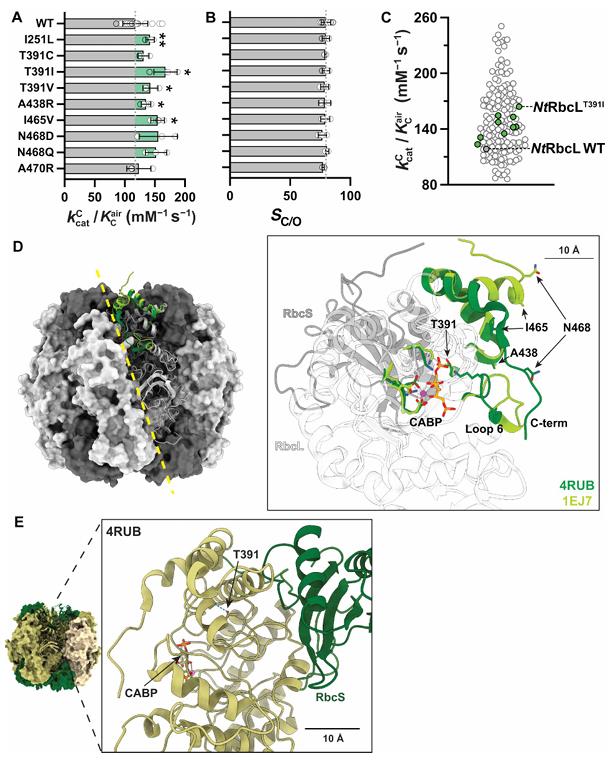
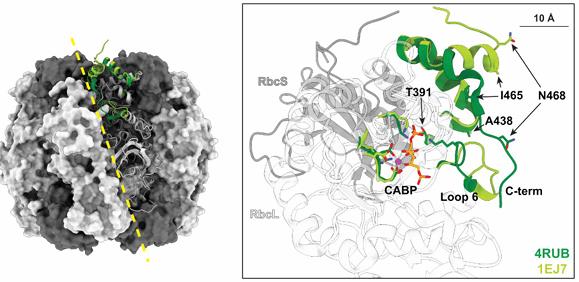
Figure 1. Kinetic measurements and structural context of engineered tobacco Rubisco variants. (McDonald, et al., 2026)
Why This Matters for Crops
Rubisco's sluggishness caps the photosynthetic ceiling of staple crops such as rice, wheat, and soybean, so variants with better carboxylation kinetics are candidates for testing photosynthetic and yield effects. The study's broader message is methodological: a structure-informed model can focus protein engineering on productive sites with a smaller experimental library than previous random-mutagenesis work, and the approach provides a basis for testing other plant Rubiscos. For crop translation, plant genetic engineering will require suitable expression and delivery systems. CRISPR-based genome editing may support complementary nuclear-gene studies, but routine editing of the chloroplast-encoded rbcL gene was not demonstrated here. Field-level gains will also depend on downstream metabolism keeping pace, a reminder that Rubisco is one cog in a larger machine.
From Model to Field
The path from a tobacco proof-of-concept to a higher-yielding field crop is not trivial. Stable expression of the redesigned large subunit must be established, with compatible nuclear-encoded small subunits and assembly machinery, while photosynthesis trait analysis will be needed to confirm whole-plant benefits rather than isolated enzyme improvements. The results show that substitutions poorly represented in surveyed plant sequences can improve tobacco Rubisco kinetics, while photosynthesis gains in the paper remain model predictions. Stable expression and whole-plant measurements are needed to evaluate those predictions.
Beyond the chloroplast engineering itself, a faster Rubisco only pays off if the rest of the photosynthetic apparatus and sink tissues can absorb the extra fixed carbon; otherwise the benefit stalls at the leaf. That systems-level coupling means the next phase of work will likely pair Rubisco redesign with adjustments to downstream metabolism, canopy architecture, and nitrogen allocation, rather than treating the enzyme in isolation. The model-guided screening and chloroplast assembly assay provide methods that researchers can evaluate for other crop Rubiscos, with species-specific validation.
Conclusion
By using a structure-informed machine learning model to prioritize mutagenesis sites, researchers identified tobacco Rubisco variants with improved in vitro kinetics and confirmed chloroplast assembly of selected variants. The work provides a template for combining predictive models with directed evolution, while improved crop photosynthesis and productivity remain goals for future validation.
Related Services & Products
Reference
- McDonald, J. L., et al. (2026). Machine learning–assisted directed evolution of plant Rubisco. Science Advances, 12, eaeh3246. DOI: 10.1126/sciadv.aeh3246.
For research or industrial raw materials, not for personal medical use!
 IMPORTANT NOTICE: BEWARE OF IMPERSONATION