TIC Condensates Connect the Circadian Clock to Salt Tolerance in Arabidopsis
The Circadian Clock as a Stress Survival Tool
Plants are rooted in place, so they cannot flee unfavorable conditions. Instead, they depend on an internal timing system—the circadian clock—to anticipate the daily swing of light, temperature, and humidity and to pre-position their defenses. In Arabidopsis and crop plants, this roughly 24-hour oscillator does far more than regulate daily rhythms: it is deeply integrated with the machinery that controls stress responses. Researchers can use plant genetic engineering to investigate how clock components contribute to stress responses.
A Clock Protein That Prefers to Congregate
TIME FOR COFFEE (TIC) is a well-known nuclear regulator of the circadian clock in Arabidopsis. The study shows that TIC forms nuclear biomolecular condensates in Arabidopsis under salt stress. Many biomolecular condensates form through liquid–liquid phase separation involving multivalent interactions, often mediated by intrinsically disordered regions. Computational predictions flagged most of the TIC protein as intrinsically disordered, and deletion analysis identified an N-terminal region with intrinsic condensation capacity. Full-length TIC formed condensates in Nicotiana benthamiana leaf cells and showed fluorescence recovery after photobleaching; purified TIC residues 1–422 formed droplets that fused in vitro. In Arabidopsis, condensates were not observed under normal conditions but appeared after salt treatment; this differed from constitutive condensation in N. benthamiana. The 423–660 region was additionally required for salt-responsive condensation in Arabidopsis. Functional dissection of such clock genes can use Arabidopsis thaliana transformation to introduce tagged or mutant constructs.
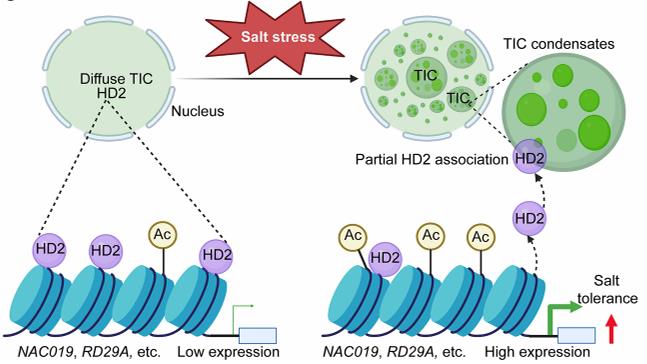
Figure 1. Working model linking salt-induced TIC condensates and partial association with HD2 proteins to reduced HD2 occupancy, increased H3K9ac, and stress-responsive gene expression in Arabidopsis. (Tian, et al., 2026)
Salt, Not Mere Osmotic Stress, Triggers the Response
A key distinction in the work is specificity. High salinity imposes both ionic toxicity and osmotic pressure, and the authors carefully separated the two. TIC condensates formed rapidly under sodium chloride treatments but did not appear when plants were stressed with mannitol or polyethylene glycol—agents that mimic osmotic stress without the sodium ion. Potassium chloride triggered condensation as well, pointing to an ionic rather than purely osmotic trigger. The droplets were dynamic and reversible: they dissolved when the salt was withdrawn or when cells were treated with 1,6-hexanediol, a reagent that disrupts weak hydrophobic interactions typical of phase-separated assemblies. The tic mutant, by contrast, was hypersensitive to salt and survived far worse than wild-type plants, supporting a role for TIC in salt tolerance.
Salt-Responsive Condensation Depends on Treatment Conditions
The experiments distinguish salt-responsive TIC condensation from the response to the tested nonionic osmotic treatments. Under the tested conditions, diverse salts induced TIC condensates, whereas mannitol, sorbitol, and polyethylene glycol did not. Because salts including KCl also induced condensation, the response is not sodium-specific. Condensates appeared within approximately 1 minute at 0.25 M NaCl, but became apparent after approximately 20–30 minutes at 0.15 M NaCl. The timing of condensation therefore depends on the treatment conditions. These findings highlight distinct salt and osmotic responses that need to be considered when testing stress-related traits.
TIC Reaches into Chromatin Through HD2
TIC physically associates with HD2-type histone deacetylases—HD2A, HD2B, HD2C, and HD2D—through both split-luciferase and co-immunoprecipitation assays. HD2 proteins are themselves concentrated in the nucleolus, and a subset showed limited spatial association with TIC condensates under salt stress. HD2-associated deacetylation can restrict H3K9ac accumulation and expression at the tested salt-responsive loci. The study proposes that TIC condensation is associated with reduced HD2 occupancy at the tested loci, allowing H3K9ac to accumulate and favoring transcription.
For researchers tracking these marks, services such as detection of epigenetic modifications in plants may support studies of chromatin regulation, with assays selected for the specific histone mark and locus. The TIC–HD2 relationship links a clock component with chromatin regulation.
From H3K9ac to Salt Tolerance: The Mechanistic Model
The TIC study examined H3K9ac and expression at selected salt-responsive loci. Under salt stress, TIC condensate formation is accompanied by reduced HD2 occupancy at salt-stress-responsive genes such as NAC019, RD20, and RD29A. In wild-type plants, H3K9ac and transcription increased at the tested genes under salt stress. Mutants lacking TIC showed reduced salt-induced H3K9ac accumulation and transcription. The hd2 genotype, combining HD2A knockdown with mutations in HD2B, HD2C, and HD2D, partially restored both in the tic background, supporting a contribution from HD2-dependent regulation.
To monitor the resulting transcriptional shifts, researchers can pair mutant analysis with gene expression profiling, which captures whether candidate loci respond as predicted.
Timing Is Everything
The tic mutant runs on a shortened ~21-hour internal period. When grown under a 21-hour light–dark cycle that matches its own rhythm, the mutant actually tolerated salt better than when its internal clock was mismatched with the environment. The 21-hour treatment used 10.5 hours of light and 10.5 hours of darkness, matching the shortened total cycle length rather than changing daylight duration within a 24-hour day. Salt-responsive genes such as NAC019 and RD29A are induced in a time-of-day-dependent manner, suggesting that the TIC–HD2–H3K9ac axis is gated by the clock in the regulation of responses across the day–night cycle. Modern transcriptome analysis can help characterize time-dependent gene expression across the genome.
Implications for Crop Improvement
The findings identify mechanisms for further investigation in salt-stress research. A mechanism that links circadian timing, phase separation, and chromatin to salt tolerance suggests new intervention points: testing TIC-related condensation, HD2-associated regulation, and interactions between circadian timing and salt responses in additional plant systems. Whether the mechanism can inform crop breeding programs requires validation in the target crop. Emerging epigenetic editing tools, which adjust chromatin states without changing DNA sequence, could support future studies of gene regulation; their application to TIC-dependent chromatin responses in crops would require separate validation.
Conclusion
The TIC study reframes the circadian clock as a physical organizer of stress responses. Through salt-induced condensation associated with reduced HD2 occupancy at the tested loci, TIC contributes to increased H3K9ac and expression at the tested stress-responsive genes in Arabidopsis. Further work is needed to test how this regulatory relationship operates in crop species and under field conditions.
Related Services & Products
Reference
- Tian, W., et al. (2026). TIME FOR COFFEE coordinates phase separation and chromatin regulation for salt tolerance. Science Advances, 12(42), eaei1213. DOI: 10.1126/sciadv.aei1213.
For research or industrial raw materials, not for personal medical use!
 IMPORTANT NOTICE: BEWARE OF IMPERSONATION