Engineering Plant Immune Receptors to Strengthen Disease Defense
Two New Roads to Programmable Immunity
Plant diseases cause substantial cereal crop losses, and pathogens can overcome resistance genes deployed in breeding. Two recent studies approach the problem from opposite ends of the plant immune system and arrive at a shared conclusion: the receptors plants use to sense threats can themselves be redesigned to alter immune signaling or effector recognition. One team re-engineered a well-known cell-surface receptor in Arabidopsis to control how it assembles; the other remodeled an intracellular receptor found in barley and wheat so that it recognizes a broader set of pathogen weapons. Both suggest ways to incorporate receptor design into plant genetic engineering programs alongside resistance-gene discovery and breeding.
The Two Fronts of Plant Immunity
Plants defend themselves through layered surveillance. At the cell surface, pattern recognition receptors sit in the plasma membrane and detect conserved microbial signatures, triggering pattern-triggered immunity. Inside the cell, a different class of receptors intercepts the effector proteins that successful pathogens inject to sabotage host defenses. Historically, breeders improved crop breeding lines by introducing naturally occurring receptor or resistance genes, although the time required and breadth of protection vary among genes and breeding programs. The papers address two questions: how assembly affects sustained FLS2 signaling, and whether tandem kinase receptors can recognize additional effectors.
- Surface surveillance: includes leucine-rich-repeat receptor kinases such as FLS2, which associate with co-receptors upon activation.
- Intracellular surveillance: depends on nucleotide-binding leucine-rich-repeat proteins and, increasingly recognized, tandem kinase proteins that carry integrated effector-binding domains.
- The FLS2 design goal: strengthen early signaling while preserving receptor turnover and responsiveness to repeated stimulation.
Tuning a Cell-Surface Receptor with Synthetic Assembly
The first study focused on FLS2, a receptor that recognizes a fragment of bacterial flagellin. Using single-particle imaging with quantitative calibration, the authors showed that FLS2 exists mostly as a monomer at rest and shows increased transient homodimeric association after activation. Engineered dimers enhanced downstream phosphorylation and reactive oxygen production, although the precise organization and activation mechanism of the receptor complex remain unresolved. The team used coiled-coil motifs to engineer FLS2 variants with defined oligomerization states.
The result was instructive. Engineered homodimeric FLS2 enhanced immune signaling and reduced bacterial colonization, but pushing the receptor into higher-order assemblies backfired: those over-assembled clusters blocked the dynamic replenishment of receptors at the membrane and thereby crippled long-lasting immune activity. The key distinction was that dimers retained effective receptor turnover, whereas higher-order assemblies impaired replenishment and responses to repeated stimulation. This principle is directly relevant to anyone working with Arabidopsis thaliana as a model, and it reframes receptor engineering as a kinetic, dosage-sensitive problem rather than a simple on/off switch.
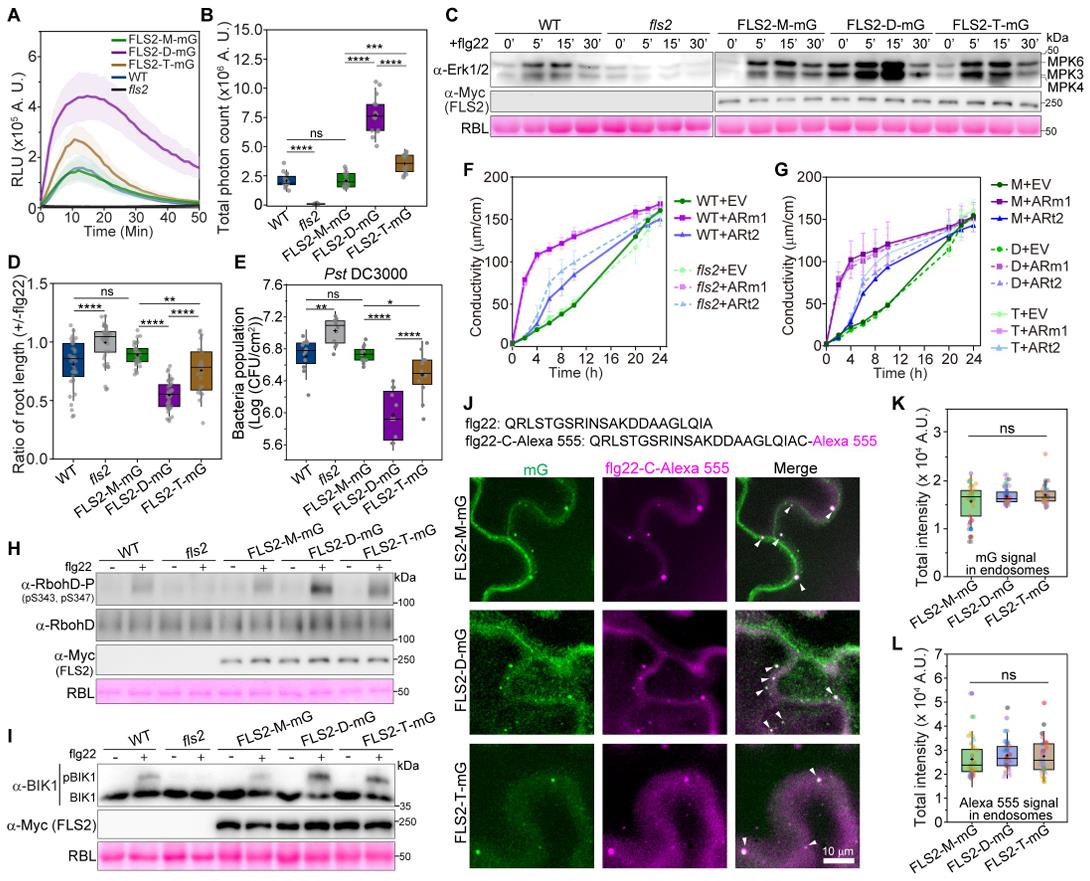
Figure 1. Synthetic control of FLS2 assembly strengthens pattern-triggered immunity in Arabidopsis. (Ma, et al., 2026)
Reprogramming an Intracellular Effector Decoy
The second study tackled the intracellular side, where tandem kinase proteins have emerged as a major, non-canonical source of disease resistance in cereal crops. In barley and wheat, receptors such as Rmo2 and Rwt7 carry an integrated heavy-metal-associated domain that acts as an effector-binding decoy. Rmo2 binds PBY2 and Rwt7 binds PWT7 from the blast fungus Magnaporthe oryzae, with dissociation constants of 53.5 nM and 2.92 nM, respectively. Mutations disrupting these interactions also disrupted resistance in cereal infection assays. The authors solved the structures of these interactions and pinpointed the exact interface residues that dictate recognition.
Building on that map, they resurfaced the integrated domains to expand effector binding. Engineered Rmo2+ recognized both PBY2 and PWT7 in wheat protoplast assays. By contrast, engineered Rwt7+ gained binding to PBY2 but did not gain a corresponding immune response in that assay. Because the integrated domain behaves as a modular, programmable unit, the work provides a basis for designing new binding specificities while testing separately whether they activate immunity. For breeders of Triticum aestivum and barley, this is a step toward resistance that can be updated as pathogen effectors evolve, although whole-plant resistance and durability of the engineered receptors still require evaluation.
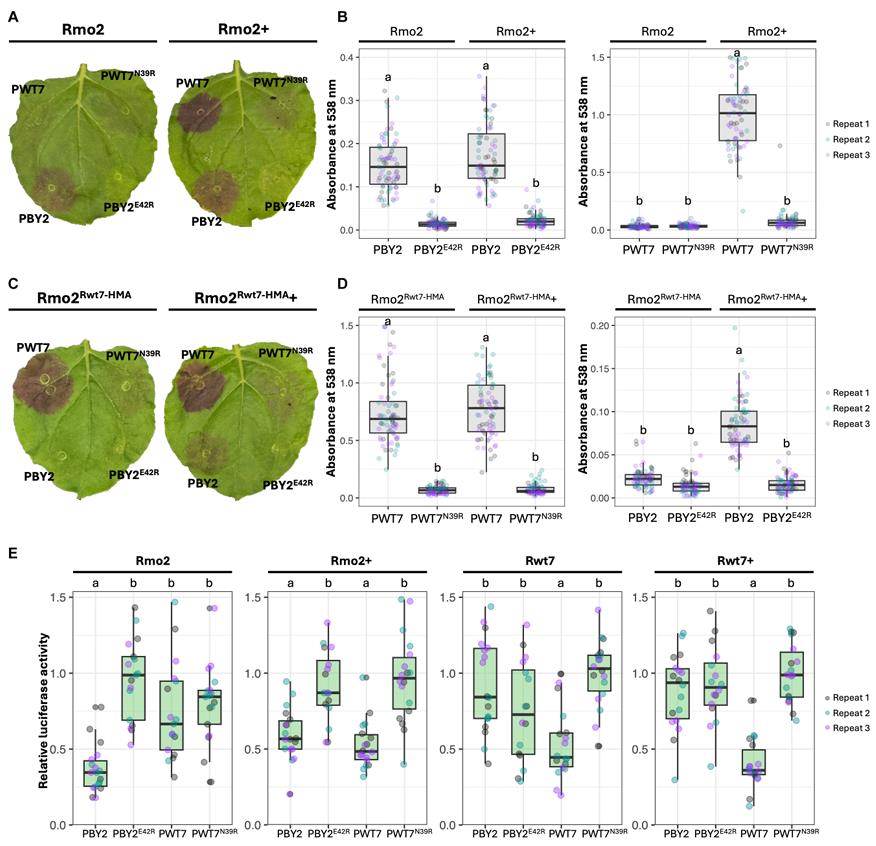
Figure 2. Resurfaced HMA domains expand effector binding in plant cells; engineered Rmo2+ recognizes both effectors in wheat protoplasts, whereas Rwt7+ does not gain a PBY2-triggered response. (Yu, et al., 2026)
From Surface to Interior: A Shared Design Rule
Although one receptor lives at the membrane and the other in the cytoplasm, both papers converge on the same idea. The studies address different design variables: assembly and turnover for FLS2, and effector-binding interfaces for tandem kinase receptors. The FLS2 work shows that assembly state—not just ligand binding—governs both the speed and the endurance of signaling. The tandem kinase work shows that a small, well-characterized interface can be rewritten to change what the receptor sees. For future crop work, CRISPR-based genome editing could complement structure-guided receptor design where the required sequence changes can be introduced and validated.
Integrated Domains as Engineering Targets
Neither strategy is isolated. The integrated heavy-metal-associated domain that makes tandem kinase proteins programmable is not unique to them: rice nucleotide-binding leucine-rich-repeat proteins such as Pik-1 and RGA5 carry the same kind of decoy module, and Rpg1 hides one at its N terminus that went unnoticed until structural modeling finally caught up. That convergence points to a general, reusable architecture—an effector-binding pocket that evolution has repeatedly co-opted and that engineers can now redesign on purpose. The shared HMA module supports comparisons between NLR and tandem kinase engineering; it is distinct from the FLS2 assembly mechanism.
Looking ahead, the designability of these receptors also changes how breeders think about durability. Instead of deploying one receptor and waiting for pathogens to break it, programs could maintain a pipeline of redesigned variants, swapping in a new recognition domain or retuning assembly as surveillance of pathogen populations demands. Such programs would require pathogen surveillance, functional testing, and evaluation in the intended crop backgrounds.
Implications for Crop Protection
The practical payoff is a move away from the boom-and-bust cycle in which a single resistance gene is deployed, overcome, and replaced. A receptor whose assembly can be dialed to the right level, or whose recognition domain can be swapped as effectors change, offers a far more flexible defensive toolkit. Combined with robust plant resistance screening and functional genomics analysis, such designed receptors could be moved from a model system into staple crops through established transformation pipelines. The challenge that remains is ensuring that engineered receptors stay specific—triggering defense against pathogens but not against the plant's own proteins—and that the assembly controls scale cleanly across diverse genetic backgrounds. Just as important is how these receptors are combined: a single redesigned receptor is unlikely to be a silver bullet, so combining receptors with distinct recognition profiles is a strategy to evaluate for broader protection.
Conclusion
These two studies reframe plant immunity as something we can deliberately shape. By controlling how a surface receptor assembles, or by rewriting the interface of an intracellular decoy, researchers can strengthen measured immune responses or broaden effector recognition in experimental systems. Translating these advances into crop protection will require validation of whole-plant resistance, growth effects, and performance across pathogen populations and environments.
Related Services & Products
Reference
- Ma, Z., et al. (2026). Synthetic FLS2 receptor oligomer boosts plant innate immunity. Science Advances, 12, eaeg6872. DOI: 10.1126/sciadv.aeg6872.
- Yu, D. S., et al. (2026). Engineering plant tandem kinase immune receptors expands effector recognition profiles. Science Advances, 12, eaef2426. DOI: 10.1126/sciadv.aef2426.
For research or industrial raw materials, not for personal medical use!
 IMPORTANT NOTICE: BEWARE OF IMPERSONATION