Ghd7 Coordinates a Cascade that Improves Rice Yield and Eating Quality
The Yield–Quality Dilemma in Rice
Rice breeders have long faced a trade-off between grain yield and eating quality. The bulk of the rice grain is starch, with protein a distant second, so the texture, taste, and cooking behavior of cooked rice hinge on how those two components are balanced. Balancing these traits remains a challenge for plant breeding. A new Nature Communications study argues that the pleiotropic gene Ghd7—already known for its effects on heading date and yield—also sits at the top of a transcriptional cascade that coordinates starch and protein, opening a path to lift both at once.
A Well-Known Gene with a New Job
Ghd7 has been a staple of rice genetics for years because it governs heading date, plant height, and the number of grains per panicle—core yield determinants. The authors noticed that near-isogenic lines carrying the Ghd7 allele from a premium eating-quality variety, DHX2, also scored higher on grain amylose content, starch content, gel consistency, and taste value, while showing lower grain protein and chalkiness. Knockout and overexpression experiments confirmed the direction: more Ghd7 meant better cooking and eating quality alongside higher yield. The gene is expressed strongly in the endosperm during grain filling, and its encoded protein localizes to the nucleus.
From a QTL to the Causal Gene
The team started with a quantitative trait locus, qAC7, that influenced grain amylose content, and narrowed it by map-based cloning to a single causal gene: Ghd7. Using QTL mapping and recombinant progeny, they pinpointed a functional variant and showed that complementation and overexpression increased amylose and reduced protein relative to their respective controls; total starch content, however, decreased in the overexpression line. The study connects this known yield regulator with grain-composition traits and downstream transcriptional regulation.
The team screened 2,400 BC4F2 plants, identified 430 recombinants in the initial interval, and used progeny testing to narrow qAC7 to an approximately 245.8-kb region. The causal variant turned out to sit within Ghd7 itself, and sequencing across parents revealed a single functional SNP distinguishing the functional DHX2 allele from the nonfunctional KY131 allele. The findings establish a role for Ghd7 in both yield-related and grain-quality traits, without implying that it is their only genetic regulator.
Ghd7 Switches On PCF3
To find the downstream effector, the authors combined chromatin immunoprecipitation sequencing with genome-wide association data and identified PCF3, a transcription factor, as a candidate downstream target. Multiple assays converged: electrophoretic mobility shift and ChIP-qPCR proved Ghd7 binds the PCF3 locus directly, a luciferase reporter showed Ghd7 enhances PCF3 transcription, and RT-qPCR confirmed PCF3 tracks Ghd7 across lines. In other words, Ghd7 is an upstream activator of PCF3. Exploring these regulatory connections is precisely the kind of work supported by gene function analysis, which can help test regulatory relationships within a pathway. For functional validation, researchers often deploy CRISPR/Cas9-mediated editing to knock out candidates and overexpression studies to test gain-of-function effects.
A Single Base That Tilts the Balance
A natural T/TA insertion–deletion variant in the third exon of PCF3 affects the encoded protein; the A insertion in the TA allele causes a frameshift. The PCF3-T allele binds strongly and represses a gene called OsNF-YC4; the PCF3-TA version does not show the same transcriptional repression. That repression is the lever on grain composition: when OsNF-YC4 is held down, starch rises and protein falls, improving both yield and eating quality. Haplotype and evolutionary analyses did not identify evidence of strong domestication selection at PCF3, highlighting an opportunity to evaluate the favorable T allele in breeding. The defined sequence difference offers a candidate for genetic engineering as well as allele introgression, with performance requiring validation in the recipient background.
The Starch–Protein Trade-Off, Explained
The cascade provides one mechanism linking grain composition with yield and eating quality. Starch and protein make up the vast majority of the endosperm, so their balance contributes to grain quality; yield also depends on components such as grain number and panicle number. By routing Ghd7 → PCF3-T → repression of OsNF-YC4, the favorable allele combination can support increased starch content and reduced grain protein content, with improved yield and eating-quality traits in the tested materials, while heading date and adaptation remain important considerations. Teams quantifying these biochemical endpoints can draw on starch research platforms, while transcriptome analysis can map how broadly the Ghd7 program reshapes the grain's gene network.
The study measured changes in grain starch and protein contents associated with the regulatory cascade. Changes in their balance should be evaluated together with measured grain-quality traits and yield components. The reported benefits depend on the alleles, genetic backgrounds, and environments tested.
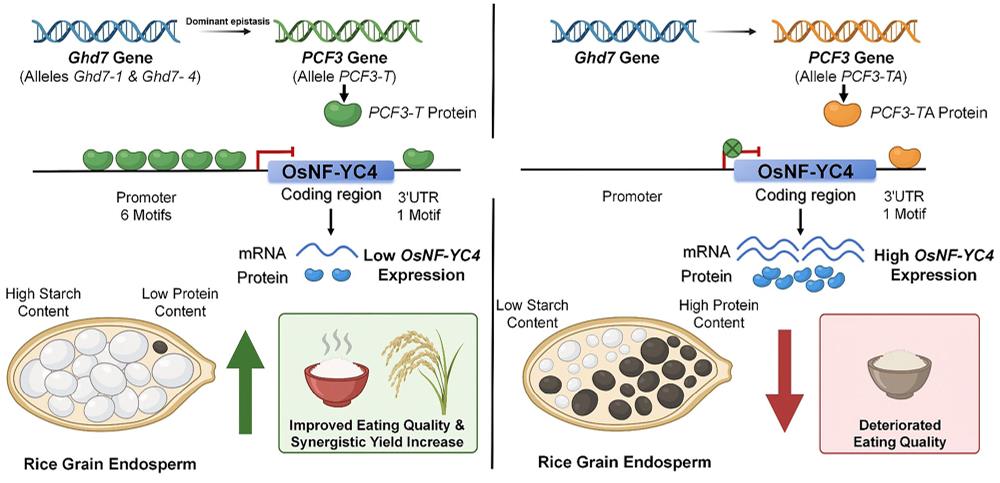
Figure 1. A working model in which Ghd7 activates PCF3, whose favorable allele represses OsNF-YC4 to rebalance starch and protein and jointly improve rice yield and eating quality. (Lou, et al., 2026)
Combining Elite Alleles for Synergy
The most practical result is combinatorial. Genotype combinations carrying Ghd7-1 or Ghd7-4 together with PCF3-T showed favorable yield and eating-quality traits, and introgression of PCF3-T into a Ghd7-4 background improved both in the tested line. Screening for PCF3-T and combining it with suitable Ghd7 alleles is a breeding strategy worth testing; the T allele was not rare across all germplasm groups examined. Confirming grain quality phenotypes across diverse backgrounds remains essential before such combinations reach farmers.
Field Performance Depends on the Environment
The authors tested the DHX2 Ghd7 allele in two contrasting rice-growing regions—Wuchang in Northeast China and Wuhan in central China. In both locations the allele raised amylose, starch, gel consistency, and taste value while lowering protein and chalkiness, but the magnitude differed between sites; photoperiod, temperature, and genotype-by-environment interactions were proposed as possible explanations. Grain number per panicle, plant height, and heading delay increased more in Wuhan, whereas the absolute increase in yield per plant was larger in Wuchang. The takeaway is that the Ghd7–PCF3 program is modulated by environment, so elite combinations must be validated region by region rather than assumed to transfer universally. Breeding pipelines should evaluate these alleles alongside local adaptation and maturity requirements.
Why It Matters for Breeding
The work extends the regulatory framework connecting Ghd7 with grain quality and yield. It supplies a mechanistic explanation for a long-observed yield–quality correlation and hands breeders a small set of actionable targets: the Ghd7 allele, the PCF3-T variant, and the OsNF-YC4 node they regulate. The defined alleles can inform marker-assisted selection, while editing approaches would require validation of the intended variant and genetic background. The findings illustrate how a transcriptional cascade can support joint improvement of traits often treated as a breeding trade-off.
Conclusion
By uncovering a Ghd7–PCF3–OsNF-YC4 axis, the study shows how one well-studied rice gene contributes to both rice yield and grain composition. The results identify allele combinations for further breeding evaluation, with heading date, genetic background, and growing environment remaining important.
Related Services & Products
Reference
- Lou, G., et al. (2026). Ghd7-triggered transcriptional regulation for synergistically improving rice eating quality and yield. Nature Communications, 17, 10570. DOI: 10.1038/s41467-026-78253-x.
For research or industrial raw materials, not for personal medical use!
 IMPORTANT NOTICE: BEWARE OF IMPERSONATION