Auxin is the plant hormone that quietly runs the show. It sets root architecture, leaf shape, flower formation, and seed size, and it does so largely by switching gene expression on and off. For decades the field has focused on how auxin reaches the nucleus and frees its transcription factors. A new study from Ban et al. turns the spotlight onto a different question: once an auxin transcription factor is made, how does the cell decide how long it should last? The answer lies in a small, easily overlooked stretch of protein that acts as a built-in timer for a whole class of repressors.
The canonical auxin pathway works through a nuclear module built from three parts. At the core are the AUXIN RESPONSE FACTORS (ARFs), DNA-binding transcription factors that directly activate or repress auxin-responsive genes. Their activity is held in check by the Aux/IAA repressors, which bind ARFs and recruit corepressors. When auxin levels rise, the TIR1/AFB F-box proteins grab the Aux/IAAs, mark them for ubiquitylation, and feed them to the proteasome — releasing the ARFs to act. Land plants typically sort their roughly two dozen ARFs into three subclasses. The class-A ARFs are generally transcriptional activators and fit the textbook model cleanly. The class-B and class-C ARFs, by contrast, tend to work as repressors, and for the large and understudied class-B branch the exact rules of engagement have remained murky even as gene function analysis of other ARFs advances.
That gap matters because class-B ARFs are not minor players. In Arabidopsis thaliana they make up 14 of the 22-member family. Loss of one of them, ARF2, produces plants that are simply bigger: enlarged rosette leaves, taller inflorescence stems, delayed senescence, and notably larger seeds. Whatever class-B ARFs are doing, dialing them down appears to release growth. Understanding the brake, then, is a prerequisite for learning how to ease it in a crop.
The clue came from earlier work in maize and the moss Physcomitrium patens, where a small instability (INS) domain tucked inside the DNA-binding region of class-B ARFs was shown to control protein stability and thereby auxin responses. The same minimal region turned up again in Marchantia polymorpha, and motif-swap analyses suggested the instability mechanism predates the split between class-A and class-B ARFs. The maize connection is especially tidy: a dominant mutant called Truffula (Trf) traced to a single S281N change in the INS domain of ZmARF28. The authors therefore asked whether the same domain governs the Arabidopsis class-B ARFs, and chose AtARF2 — the closest Arabidopsis ortholog of ZmARF28 — as their test case.
They substituted the conserved threonine at position 298 of ARF2 with amino acids of distinct chemistry: alanine (T298A), asparagine (T298N), aspartic acid (T298D), and glutamic acid (T298E). Driving each version from the native promoter let them read the phenotypes against the background of normal expression patterns. The results were sharply graded and immediately informative.
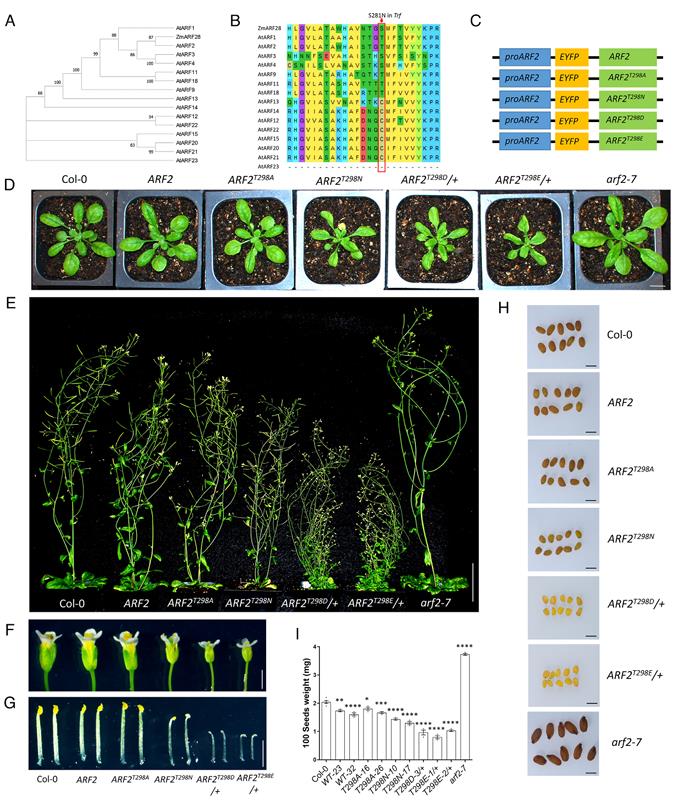
Figure 1. Transgenic Arabidopsis lines carrying stabilized ARF2 variants show pleiotropic defects spanning leaves, flowers, stamens, and seeds. (Ban, et al. 2026)
The T298A substitution, a non-phosphorylatable control, looked essentially wild type. The T298N line — the direct analog of the maize Trf mutation — sat in the middle, with compromised fertility in a subset of homozygous lines. The T298D and T298E lines, however, were dramatic. Plants were small with curled rosette leaves, reduced height, and a bushy stature; floral organs were shrunk, the gynoecium protruded, and the lines were completely infertile. Dissecting the flowers exposed the cause: shortened filaments, markedly reduced anthers, and an absence of pollen — a clear case of male sterility. Seeds from these lines were also smaller than wild type.
The direction of the effect is the key insight. The arf2 loss-of-function mutant does the opposite of the stabilized variants: it grows more, not less. That reciprocal pattern tells us the phenotypes arise not from broken ARF2 function but from too much of it. A mutation that should have accelerated ARF2 destruction instead let the protein accumulate, and the surplus repressor choked off the auxin response.
The root system gave the cleanest view of the timer at work. Wild-type ARF2 is present in root epidermal cells early but fades as those cells differentiate and initiate root hairs. In the T298D and T298E lines, ARF2 instead persisted in nuclei of multiple cell types in the differentiation zone, including epidermal cells, and the root hairs that formed there were shorter and branched. Crossing the lines to the DR5:Luciferase auxin reporter — a classic readout for gene expression profiling — told the same story quantitatively: the stabilized variants showed reduced reporter activity and, after auxin treatment, a markedly smaller fold-change than wild type. They were, in short, auxin-resistant.
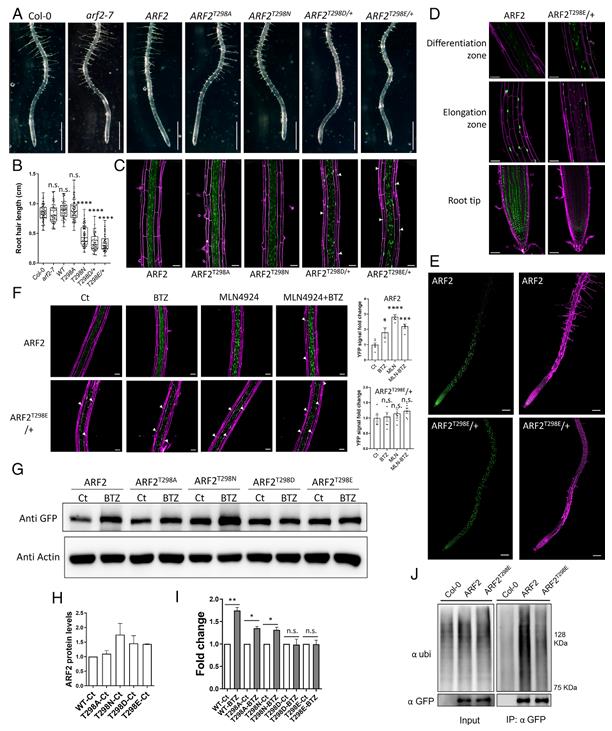
Figure 2. Stabilizing mutations in the ARF2 instability domain cause persistent nuclear accumulation in root epidermal cells and stunt root hair elongation. (Ban, et al. 2026)
Two lines of evidence pinned the cause to protein turnover. First, the stabilized variants showed weaker ubiquitylation, the molecular tag that normally flags ARF2 for destruction. Second, treating seedlings with bortezomib (a proteasome inhibitor) or MLN4924 (a neddylation inhibitor that blocks Cullin-RING E3 ligase activity) boosted wild-type ARF2 levels strongly but left the T298E variant essentially unchanged — because it was already stable. Western blots confirmed the pattern. The INS domain, then, is the handle by which the Cullin-RING machinery grabs ARF2 and feeds it to the proteasome. A charge at position 298, mimicked by aspartic or glutamic acid, appears to shield that handle.
The chemistry is suggestive of a familiar regulatory logic. Serine and threonine are classic post-translational modification sites, and aspartic and glutamic acid are routinely used as phospho-mimetic substitutes. The fact that only the negatively charged substitutions destabilized ARF2 raises the possibility that phosphorylation of this conserved residue helps trigger turnover — a hypothesis the authors flag for future work, since they could not capture a phosphorylated form directly, likely because any such mark would be transient.
One protein making a good story is not enough; the authors wanted to know whether the INS domain is a general feature of class-B ARFs. They turned to ARF3, an unusual member that lacks the C-terminal PB1 domain used by other ARFs to dimerize. Introducing the equivalent S293N and S293E changes produced similar developmental defects and increased protein stability, with both lines showing elevated protein levels, auxin-resistant root growth, and reduced DR5:Luciferase responses. The stabilization was partial rather than absolute — ARF3 variants still accumulated further under proteasome inhibition — indicating the domain is conserved but that other regions also contribute to ARF3's stability. The shared behavior across ARF2 and ARF3 is strong evidence that instability-domain-mediated control is a common thread running through the class-B branch in land plants.
The translational takeaway is direct. Class-B ARFs are repressors of the auxin response, and their levels are set post-translationally by a conserved instability domain. Removing or damping them — as the arf2 loss-of-function mutant shows — lifts repression and promotes growth, larger organs, and bigger seeds. That positions the INS domain and its regulatory inputs as a precise, tunable dial on plant stature and yield, distinct from the slower, expression-level levers breeders usually pull.
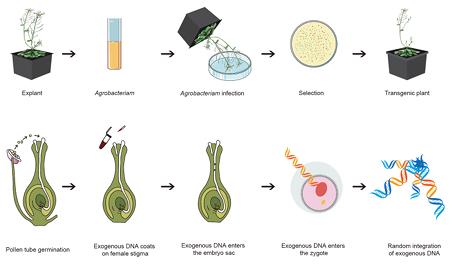
For applied plant genetic engineering this is an attractive target. Rather than overexpressing or knocking out a transcription factor and hoping for the best, one could introduce a single, defined amino-acid change in the INS domain to nudge protein half-life — a finely graded intervention that the maize Trf mutant and this study show can swing phenotypes from wild type to severely altered. Base editors and prime editors — extensions of CRISPR/Cas9 — are well suited to installing exactly such point changes without leaving a transgene behind, while classical knockout or overexpression approaches remain valuable for probing the repressor's downstream network. Coupling either strategy to molecular breeding and careful root and agronomic phenotyping would let a team ask, crop by crop, how much class-B ARF braking the plant can afford.
Get Latest Lifeasible News and Updates Directly to Your Inbox