Unlike animals, plants cannot run away from their surroundings. They are sessile organisms that must endure whatever the environment throws at them — wind gusts, raindrops, the trampling of passing herbivores, and even the physical pressure of neighboring plants competing for light. Over evolutionary time, plants have developed sophisticated ways to perceive and respond to these mechanical forces. When a plant is repeatedly touched or brushed, it undergoes a well-documented developmental reprogramming called thigmomorphogenesis: stems become shorter and thicker, flowering may be delayed, and stomatal patterns shift. This is not damage — it is an adaptive remodeling that helps the plant withstand future mechanical stress.
Beyond this visible growth response, mechanical stimulation triggers a rapid molecular cascade inside plant cells. Within seconds of being touched, calcium ions surge, reactive oxygen species appear, and hundreds of genes change their expression. Among the earliest and most consistent signatures of this response is the phosphorylation (activation) of two mitogen-activated protein kinases, MPK3 and MPK6. Researchers first observed this phenomenon in Arabidopsis more than 25 years ago, yet the upstream components that connect a physical touch on the leaf surface to MPK3/6 activation remained stubbornly unclear. A new study published in Nature Communications has now filled this gap, identifying the complete three-tiered kinase cascade that translates mechanical force into a transcriptional response — with direct implications for crop breeding and stress-resilience strategies.
The research team began by asking a straightforward question: which kinases sit above MPK3 and MPK6 in the touch-response pathway? In plant MAPK cascades, the typical architecture follows a three-step relay: a MAP kinase kinase kinase (MAPKKK) activates a MAP kinase kinase (MKK), which in turn phosphorylates and activates a MAP kinase (MPK). While MPK3 and MPK6 were known terminal players, their direct activators for touch signaling had never been confirmed.
To address this, the researchers examined loss-of-function mutants of several candidate MKKs. They focused initially on MKK4 and MKK5 — two closely related kinases already implicated in wound and pathogen responses. Using quantitative RT-PCR on a panel of established touch marker genes, they found that the mkk4 mkk5 double mutant showed dramatically reduced induction of numerous touch-responsive genes after gentle brushing. Genes regulated by CAMTA transcription factors (a JA-independent branch of touch signaling), such as TCH2, TCH4, CRK41, and PP2A5, were all significantly less induced. In contrast, JA-dependent markers such as ERF109 were largely unchanged in the mkk4/5 mutant, indicating that MKK4 and MKK5 operate primarily in a JA-independent branch of the touch response. This positioned MKK4 and MKK5 as central regulators of the early touch transcriptional program.
To get a genome-wide view, the team performed RNA sequencing on wild-type and mkk4/5 mutant seedlings before and 22 minutes after touch treatment. The results were striking: among the approximately 905 touch-responsive genes differentially affected in the mkk4/5 mutant, roughly 779 (~86%) required MKK4 or MKK5 for their full induction. Equally important, the MKK4/5-dependent transcriptome shared broad similarity with that of the camta1/2/3 mutant, suggesting that the MKK4/5-MPK3/6 module and the CAMTAs may converge or act in parallel to drive the majority of the early touch response. This kind of systems-level insight is precisely what modern transcriptome analysis can reveal, connecting mutant phenotypes to global gene regulatory networks.
Because MKK4 and MKK5 are themselves kinases, the researchers next asked whether they control protein-level phosphorylation events that follow touch. They conducted a time-course phosphoproteomics experiment, sampling wild-type, JA-deficient (aos), and mkk4/5 mutant plants at 0, 1, 3, and 10 minutes after brushing, followed by tandem mass spectrometry.
The data delivered two major insights. First, in wild-type plants, touch triggered rapid and widespread changes in protein phosphorylation: 488 phosphosites on distinct proteins were significantly altered within 10 minutes, with most changes occurring by the 3-minute mark. Motif analysis revealed that the canonical MAPK target motifs (threonine-proline and serine-proline) accounted for the largest fraction of these sites — a strong fingerprint of MAPK activity. The affected proteins spanned diverse functional categories: other kinases and phosphatases, calmodulin-binding proteins, transcription factors, auxin transporters, defense-related enzymes, and even mechanosensitive channel proteins such as MSL5.
Second, and more dramatically, the mkk4/5 mutant showed virtually no touch-induced phosphorylation changes compared to wild type. In stark contrast, the JA-deficient aos mutant exhibited a phosphorylation pattern nearly identical to wild type. This means that MKK4 and MKK5 are the dominant drivers of the entire early touch phosphoproteome, while jasmonic acid — despite its importance for touch-regulated gene expression — plays little role in the first wave of protein phosphorylation after mechanical stimulation. The team verified this conclusion directly using immunoblotting with anti-phospho-MAPK antibodies: MPK3 and MPK6 phosphorylation spiked within one minute of touching in wild-type plants but was completely abolished in the mkk4/5 mutant. This approach, combining proteomics analysis with targeted validation, provides a template for how functional genomics analysis can dissect signaling networks in unprecedented detail.
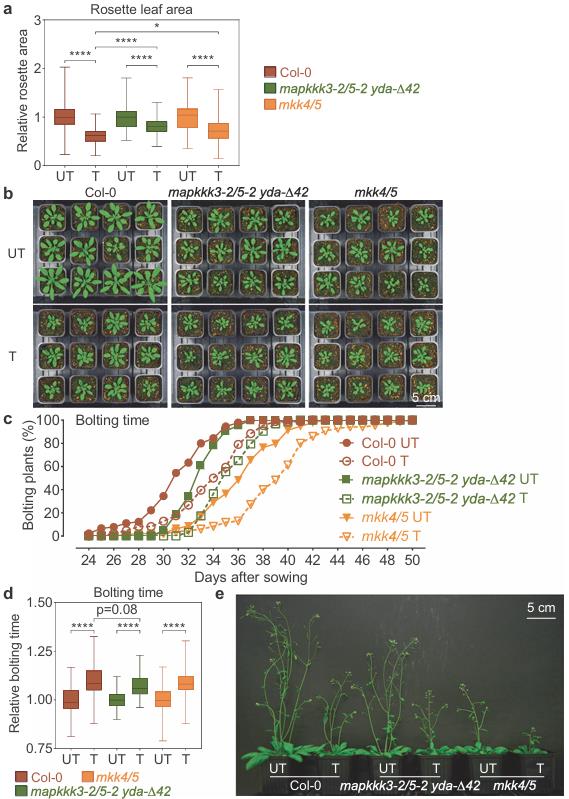
Figure 1. Loss of the MAPKKK3/4/5-MKK4/5 cascade impairs thigmomorphogenic responses in Arabidopsis. (Tran, et al. 2026)
With MKK4 and MKK5 confirmed as the critical middle tier, the hunt turned to the top of the cascade: which MAPKKKs activate MKK4/5 upon mechanical stimulation? The phosphoproteomic dataset itself provided the clue. Several MAPKKK family members — notably MAPKKK3, MAPKKK5, and YODA (also known as MAPKKK4) — showed increased phosphorylation within minutes of touching. This made them prime candidates for the long-sought upstream regulators.
The researchers obtained and tested a series of mutants: a mapkkk3 mapkkk5 double mutant and a mapkkk3 mapkkk5 yda-Δ42 triple mutant (carrying a partial deletion in YODA). Touch-induced gene expression assays revealed a clear pattern: the double mutant showed impaired induction of some CAMTA-regulated genes (WRKY30, PP2A5), while the triple mutant had a much stronger defect, failing to properly induce nearly all MKK4/5-dependent touch genes including CRK41, TCH3, ERF019, and CML40.
Immunoblotting sealed the case. In wild-type plants, both touch and wounding treatments caused robust MPK3/6 phosphorylation. The mapkkk3/5 double mutant showed markedly reduced phosphorylation, and the triple mutant showed almost none — mirroring the phenotype of the mkk4/5 mutant itself. Together, these results establish MAPKKK3, MAPKKK5, and YODA (MAPKKK4) as the upstream activators that complete the full MAPKKK3/4/5 → MKK4/5 → MPK3/6 cascade for mechanical signaling in plants.
An intriguing additional finding was that MAPKKK3, MAPKKK4, and MAPKKK5 are themselves phosphorylated in response to touch — and this phosphorylation depends on MKK4/5. This reveals a feedback loop within the cascade, likely serving to either amplify or fine-tune the signal once activated. Such feedback mechanisms are common in plant immune signaling and may help ensure that the touch response is appropriately scaled to the intensity and duration of the stimulus.
All of this molecular detail raises a fundamental question: does the MAPKKK3/4/5-MKK4/5-MPK3/6 cascade actually matter for the whole-plant growth changes that define thigmomorphogenesis? To find out, the team subjected wild-type and mutant plants to a realistic touch regimen: twice-daily gentle brushing over two weeks, then measuring rosette size and bolting time.
The results were clear-cut. Wild-type Arabidopsis plants reduced their rosette leaf area by approximately 38% after two weeks of regular touching, and they flowered about three days later than untouched controls. In contrast, the mapkkk3/5 yda triple mutant showed only about 20% reduction in rosette size — significantly less than wild type. The mkk4/5 double mutant displayed an intermediate phenotype (~28% reduction). The triple mutant also showed a trend toward reduced bolting delay compared to wild type, though this did not reach statistical significance (p = 0.08). These data demonstrate that the identified MAPK cascade is not just a biochemical curiosity; it is functionally required for normal thigmomorphogenic development.
This connection between a rapid phosphorylation cascade and longer-term growth adjustments is particularly relevant for agriculture. Thigmo-priming — the enhanced stress resistance that plants acquire through repeated mechanical stimulation — has been shown to improve tolerance to fungal pathogens like Botrytis cinerea and to drought. Understanding the genetic machinery behind this priming effect opens doors for plant genetic engineering approaches aimed at breeding crops that are naturally more resilient to wind, lodging, and mechanical stress without requiring physical handling in the field.
A notable aspect of this study is the relationship — or relative independence — between the MAPK cascade and the jasmonic acid (JA) pathway. JA has long been recognized as a key hormone in touch and wound responses, and JA-deficient mutants show clear defects in thigmomorphogenesis and in the expression of many touch-induced genes. However, the phosphoproteomic data presented here tell a different story for the earliest phase of the response: loss of JA has minimal impact on protein phosphorylation within the first 10 minutes after touch, whereas loss of MKK4/5 essentially abolishes it.
This suggests a model in which the MAPK cascade and the JA pathway operate largely in parallel during the initial moments after mechanical stimulation. The MAPKKK3/4/5-MKK4/5-MPK3/6 module rapidly phosphorylates downstream targets and activates a large set of JA-independent genes (many overlapping with the CAMTA regulon). Concurrently, JA biosynthesis proceeds more slowly, eventually activating MYC2/3/4-dependent genes through a separate route. There is some crosstalk — certain JA-responsive genes show partial dependence on MPK3/6 — but the bulk of the early phosphorylation wave appears to be JA-independent. Disentangling these parallel branches will be an important direction for future work, particularly for understanding how plants integrate multiple signaling channels into a coherent adaptive output.
The identification of a complete MAPK cascade for mechanical signaling fills a quarter-century gap in plant biology and opens several translational avenues. From a basic-science perspective, the phosphoproteomic dataset generated in this study serves as a rich resource for identifying specific effector proteins whose phosphorylation executes touch-induced changes in gene expression, growth, and defense. From an applied standpoint, the pathway components represent potential targets for CRISPR-based genome editing strategies aimed at modulating thigmomorphogenic traits in crops.
Imagine, for example, engineering varieties that exhibit stronger thigmo-priming responses — developing sturdier stems to resist lodging under windy conditions, or mounting faster defensive reactions when insects begin to feed. Conversely, in contexts where mechanical sensitivity limits productivity (such as in dense plantings where neighbor contact constantly triggers growth suppression), dampening specific nodes of the cascade could help maintain higher yields. The tools to explore these possibilities — from targeted mutagenesis to allele-specific editing of phosphorylation sites — are increasingly accessible, making this an exciting time to translate mechanosignaling knowledge into agricultural innovation.
This study delivers a satisfying answer to a long-standing question in plant biology: how do cells convert the physical sensation of being touched into a coordinated molecular response? By combining genetics, transcriptomics, and phosphoproteomics, the research team has mapped out a complete MAPKKK3/4/5-MKK4/5-MPK3/6 cascade that activates within one minute of mechanical stimulation, drives the expression of nearly 800 genes, and is essential for normal thigmomorphogenic development. The findings also clarify the relationship between rapid phosphorylation signaling and the slower JA hormone pathway, revealing them as largely parallel arms of the touch response that converge on overlapping but non-identical gene sets. As single-cell and spatial omics technologies continue to advance, we can expect even finer resolution of how individual cell types within the plant body contribute to this remarkable sensory system — bringing us closer to crops that are not just resilient, but intelligently responsive to their mechanical environment.
Get Latest Lifeasible News and Updates Directly to Your Inbox