Common bean (Phaseolus vulgaris) is among the most important grain legumes for human nutrition, supplying up to a third of daily protein intake in vulnerable populations across Latin America and East Africa. Its productivity, however, is repeatedly undermined by viral disease, and none is more damaging than bean common mosaic disease. The agents behind it are two closely related potyviruses: bean common mosaic virus (BCMV) and bean common mosaic necrosis virus (BCMNV). Because chemical control of plant viruses remains largely ineffective, durable genetic resistance mediated by resistance (R) genes is the most sustainable line of defense. For nearly one hundred years, breeders have relied on a single dominant gene, known simply as I, to protect bean crops against a broad spectrum of potyviruses. Remarkably, despite a century of intensive deployment, no strain has ever been reported to break I-mediated resistance. Yet the molecular identity of this legendary gene stayed unresolved until now, largely because the region that carries it is one of the most structurally complex corners of the bean genome. This is precisely the puzzle that recent work in plant breeding and functional genomics has now solved.
The I gene sits at the distal end of chromosome 2, embedded in a large, multigenic resistance cluster that also guards the plant against comoviruses, a bacterial pathogen (Pseudomonas syringae pv. phaseolicola), and a fungal pathogen (Colletotrichum lindemuthianum). Immune receptors of this kind belong to the nucleotide-binding leucine-rich repeat (NLR) family, subdivided by their N-terminal domain into TNLs, CNLs, and RNLs. The I region is unusually rich in TNLs, and the repeated sequences plus a strongly suppressed recombination rate made classical positional cloning strategies fail again and again. Long-read sequencing was the breakthrough that finally made the cluster tractable.
By combining PacBio HiFi long-read sequencing with in situ Hi-C scaffolding, the authors built chromosome-level assemblies of two widely used cultivated genotypes with contrasting origins: BAT93 (Mesoamerican) and JaloEEP558 (Andean). The resulting pseudomolecules span 11 chromosomes, with scaffold N50 values above 49 Mb and BUSCO completeness scores near 97%, placing these among the highest-quality bean genomes produced to date. Comparative whole-genome sequencing and synteny analysis revealed that, although the two genotypes share overall genome architecture, the I cluster itself is dramatically different between them.
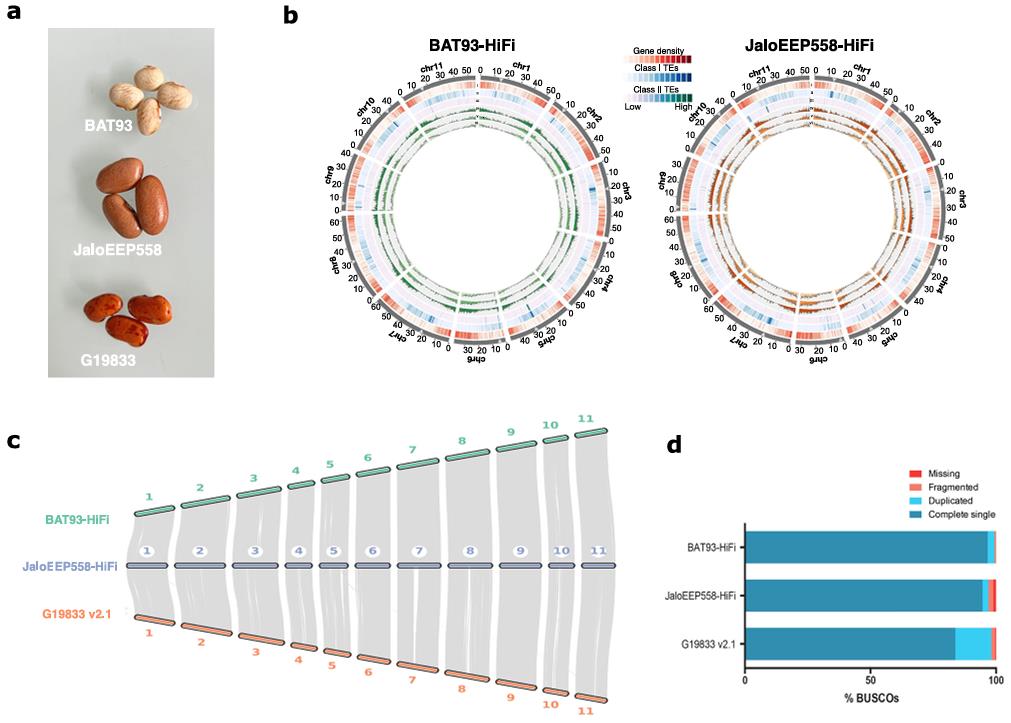
Figure 1. Chromosome-scale assemblies of two common bean genotypes (BAT93 and JaloEEP558) and their synteny with the reference genome. (Alvarez-Díaz, et al. 2026)
When the I cluster was compared across six bean genomes, the copy number of TNL genes varied from a single copy in JaloEEP558 to 34 in the genotype 5-593. BAT93 itself carries 32 TNLs across more than 700 kb, whereas JaloEEP558 packs just one TNL into less than 100 kb. Genotypes that carry the I gene consistently harbor many TNLs, while those lacking it are more diverse and gene-poor at this locus. To pinpoint the causal gene, the team screened an EMS-mutagenized BAT93 population and recovered a loss-of-function mutant, BAT93-M822, that lost resistance to BCMNV. A second, spontaneously arising BAT93 mutant, BAT93-TE, was found in the greenhouse. Both mutants carry lesions in the same TNL gene (chr2g0069161), and a cross between them produced uniformly susceptible progeny, confirming that this single gene is the I gene. The protein it encodes is a TNL of 1,332 amino acids with a TIR domain, an NB-ARC domain, 23 leucine-rich repeats, and a C-terminal jelly-roll/Ig-like domain. Deeper insight into such receptors is available through functional genomics analysis, and the transcriptional programs they engage can be profiled with transcriptome analysis.
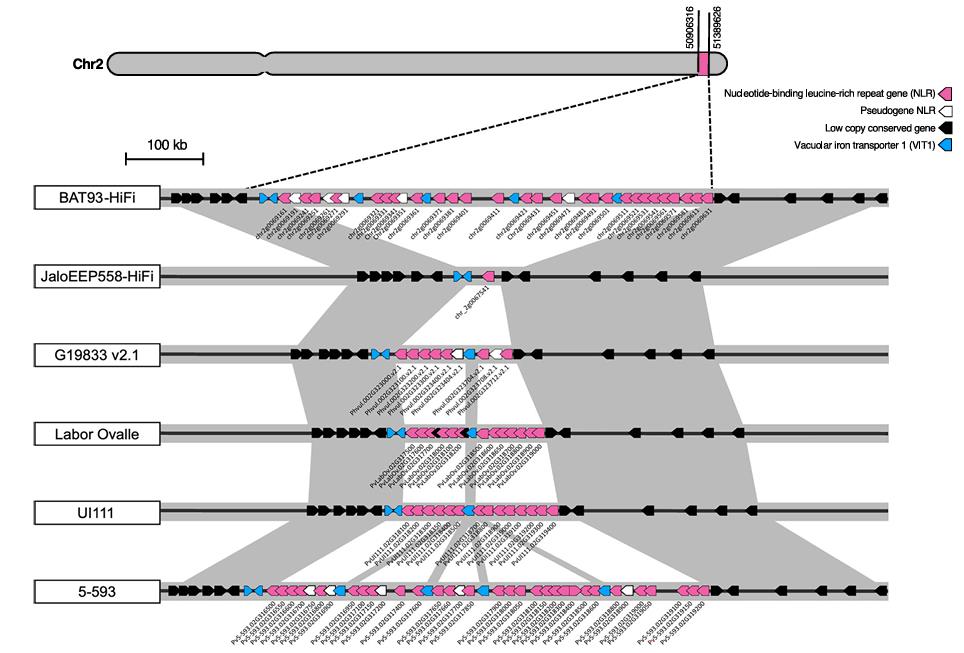
Figure 2. Physical map of the I gene cluster on chromosome 2, showing the TNL arrangement and the retrotransposon insertion that disrupts I function. (Alvarez-Díaz, et al. 2026)
The most unexpected discovery came from the BAT93-TE mutant. Roughly 6.5 kb of sequence had inserted into the I gene, and annotation showed it to be a non-autonomous LTR retrotransposon of the Ty3/Gypsy Retand lineage, named Retand I. Unlike autonomous elements, it lacks the integrase and ribonuclease H functions needed for self-propagation. Two hallmarks marked it as a very recent insertion: its long terminal repeats were 100% identical, and it was present in the BAT93-HiFi assembly yet absent from an older BAT93 assembly and from the corresponding BAC clone. In other words, the element jumped into the I gene during seed multiplication in the greenhouse, providing a rare real-world example of transposon-mediated R gene inactivation in a crop. The broader survey showed that Phaseolus genomes are distinctly enriched in Retand elements compared with pea and soybean, which are instead dominated by Ogre elements, and that Retand I transcription is induced by BCMNV infection, echoing stress-activated retrotransposons described in maize and tobacco.
Phenotyping the two mutants established that the I gene confers extreme resistance to multiple potyviruses. The study experimentally validated resistance against four viruses—BCMV, BCMNV, zucchini yellow mosaic virus (ZYMV), and watermelon mosaic virus (WMV)—all of which infected the mutants while leaving wild-type plants clean. Genomic analysis further indicates that the I locus is associated with resistance to at least five additional potyviruses: cowpea aphid-borne mosaic virus (CABMV), Thailand passiflora virus (ThPV), soybean mosaic virus (SMV), bean yellow mosaic virus (BYMV), and clover yellow vein virus (ClYVV). Intriguingly, both mutants remained resistant to bean pod mottle virus (BPMV), a comovirus also mapped to the I cluster, proving that I and the BPMV resistance gene R-BPMV are two separate R genes sharing the same genomic neighborhood. The work also clarified a long-standing agronomic headache. In I-bearing genotypes, BCMNV triggers a systemic necrosis often called "black root" disease at all temperatures, while BCMV strains can induce temperature-dependent systemic necrosis only when temperatures exceed 30°C. This destructive response is especially problematic in Central and East Africa where BCMNV is endemic. Tools such as plant pathogen detection remain essential for diagnosing which virus is actually at play in the field.
Cloning the I gene immediately yielded a practical tool: a PCR-based diagnostic marker, I-149, that amplifies specifically within the I gene and therefore cannot be separated from it by recombination. This is a major advantage over markers that sit some distance away. The marker enables marker-assisted breeding to pyramid the dominant I gene together with recessive resistance genes (such as bc-1, bc-2, bc-3, bc-ur, and bc-ud), a strategy that stacks complementary defenses and helps suppress the systemic necrosis that BCMNV otherwise provokes in I genotypes.
With the gene in hand, the door opens to targeted improvement rather than mere deployment. A useful analogy comes from potato, where mutagenesis of the Rx immune receptor reshaped its recognition spectrum and eliminated collateral necrosis. Similar protein-engineering logic could be applied to I to retain broad potyvirus resistance while removing the temperature-dependent necrosis liability. Modern plant genetic engineering makes this realistic: CRISPR-based genome editing delivered through viral vectors offers a transgenic-free route to rewrite the I coding sequence, and DNA-free genome editing avoids stable transgene integration entirely. Complementary approaches such as gene overexpression can be used to test variants and tune immune outputs in model and crop contexts.
The cloning of the I gene closes a nearly hundred-year-old chapter in bean genetics and reframes it as a story of a single TNL embedded in a restless, copy-number-variable NLR cluster. It demonstrates how combining long-read assemblies with spontaneous or induced mutants can resolve recalcitrant questions in plant disease resistance and genome evolution, and it turns an enigmatic field resistance gene into a precisely usable, engineerable asset. For breeders and biotechnologists working with genetic transformation and resistance identification, the I gene now offers both a robust marker and a clear target for building the next generation of virus-resistant common bean.
Get Latest Lifeasible News and Updates Directly to Your Inbox