Nitrogen availability is one of the most powerful constraints on plant productivity worldwide. In aerobic soils, nitrate is the dominant form of bioavailable nitrogen, yet its concentration fluctuates sharply across space and time. Farmers and researchers therefore face a persistent problem: how can we measure the nitrogen that plants actually encounter, rather than the nitrogen that a laboratory assay extracts from a soil sample?
Traditional methods such as cadmium-reduction colorimetry, ion chromatography, and ion-selective electrodes each provide useful snapshots, but they require physical sampling and cannot capture the dynamic, plant-integrated nature of nitrate availability. Electrochemical sensors drift in heterogeneous soil, and remote-sensing approaches infer nitrogen status indirectly from canopy reflectance. These trade-offs limit our ability to manage nitrogen precisely, contributing to both yield loss from under-fertilization and environmental harm from over-fertilization. Plant breeding and precision agriculture both depend on better nutrient diagnostics, so a measurement strategy that reports nitrate as plants experience it would be a major advance.
Microbial biosensors have been developed to detect nitrate in the rhizosphere, but microbes experience soil chemistry differently from plant roots. Because plants absorb, transport, and assimilate nitrate through dedicated uptake systems, a readout measured inside plant tissue is intrinsically more relevant to crop nutrition. This gap between extracted-soil chemistry and plant biology motivates the development of plant-integrated sensors that translate nitrate perception directly into a measurable signal.
The new study takes a synthetic-biology approach by building a genetically encoded nitrate reporter inside Arabidopsis thaliana. The sensor exploits the plant's own nitrate-sensing machinery, centered on the transcription factor NLP7. When nitrate enters a cell, NLP7 derepresses nitrate-responsive transcription, a process that the authors hijacked to drive a luciferase reporter. The result is a "sentinel plant" whose luminescence rises in proportion to the bioavailable nitrate it has taken up.
A ratiometric architecture was chosen so that the nitrate-responsive output could be normalized against a constitutive reference. This corrects for variation in transformation efficiency, tissue amount, and expression level, allowing quantitative comparison across independent samples and time points. The team coupled an inducible Gaussia luciferase variant, GeNL, with a constitutive NanoLuc, NLuc, and placed the two transcriptional units in a tail-to-tail orientation. This arrangement minimizes promoter occlusion and read-through, preserving signal fidelity. The final design also swaps the commonly used minimal 35S promoter for a minimal tomato dihydroflavonol 4-reductase promoter, which lowers background while preserving strong nitrate induction. The synthetic promoter contains four tandem NLP7 binding sites, a configuration that balances high induction with low basal activity.
This work illustrates how plant genetic engineering can move beyond single-gene modifications and build integrated reporter circuits. Stable transgenic lines expressing the optimized sensor were generated, demonstrating that the architecture functions reliably after genomic integration. Three independent homozygous lines showed dose-dependent responses with Michaelis-Menten kinetics, and the selected Line #2 was used for downstream soil and microbial assays. Arabidopsis thaliana transformation thus serves as both a model and a launchpad for transferring the sensor to crop species.
Several design decisions were systematically tested to maximize dynamic range and specificity. The researchers first compared four cassette orientations in mesophyll protoplasts: head-to-head, head-to-tail, tail-to-head, and tail-to-tail. Only the tail-to-tail layout matched the reference condition of separately cotransfected plasmids, confirming that convergent transcription reduces interference between adjacent reporter cassettes. This observation reinforces a broader principle in plant synthetic biology: compositional context, not just genetic parts, shapes circuit behavior.
Reporter brightness was another key variable. The optimized GeNL/NLuc pair produces roughly ten- and fifty-fold higher signal than the earlier ELuc/RedF pair, improving the signal-to-noise ratio. The number of NLP7 binding sites also mattered: two sites failed to respond, while four, six, and eight sites gave progressively more basal leakage. Four sites delivered a 53-fold induction between nitrate-free and nitrate-sufficient conditions, outperforming a previously published 4xNRE-min-LUC reporter by approximately 2.5-fold.
Specificity testing showed that the sensor is activated by nitrate but not by ammonium, urea, glutamine, or phosphate. This selectivity is important because previous nitrate-responsive promoters were often suppressed by ammonium, complicating interpretation in real soils where multiple nitrogen forms coexist. The sensor also maintained performance across pH values from 5.5 to 7.5 and reversed when nitrate was removed, meaning that output reflects current availability rather than a lingering memory of past exposure. These properties are essential for any device meant to operate in fluctuating field conditions.
Beyond protoplasts, the sensor was evaluated in intact seedlings through transient transformation and in stable transgenic lines. In transient assays, the response followed Michaelis-Menten kinetics with a near-linear region between 0 and 1 mM nitrate and saturation above 3 mM, mirroring many physiological nitrate responses. Stable lines showed even higher maximal output and lower apparent Km, suggesting that genomic integration improves sensitivity. Importantly, the sensor could be read by applying luciferase substrate directly to excised leaves without homogenization or extraction, representing a step toward simplified whole-plant readouts. Fully non-destructive, in situ detection would require future integration of autonomous bioluminescence or fluorescent reporters compatible with intact-plant imaging.
The architecture was also transferred to tomato (Solanum lycopersicum cv. Micro-Tom) via transient transformation, where it produced a clear, dose-dependent response. The dynamic range in tomato was lower than in Arabidopsis, largely because the constitutive Nos promoter drove higher NLuc expression, but the result proves that the NLP7-responsive module can function across species. For broader crop deployment, the synthetic promoter could be retuned with species-matched NLP7 binding sites and minimal promoters.
The transition from agar plates to agricultural soils is where most biosensors fail. Soils are chemically complex, physically heterogeneous, and biologically active, any of which can distort a reporter signal. To test robustness, the researchers grew sentinel plants in soils collected from four California field sites: Davis, Riverside, Five Points, and Hanford. These soils differed in background nitrate, texture, pH, and microbial community.
Sentinel plant output tracked analytically measured nitrate levels with perfect rank correlation across all four soils. Davis soil produced only baseline sensor activation, Riverside and Five Points gave intermediate responses, and Hanford soil generated the strongest signal. When low-nitrate Davis soil was amended to 10, 35, 105, or 200 ppm nitrate, the sensor responded in a dose-dependent manner across the entire agronomically relevant range. These results establish that plant-based biosensors can report plant-accessible nitrate within complex soil matrices, complementing conventional soil nutrient analysis with a biologically integrated readout.
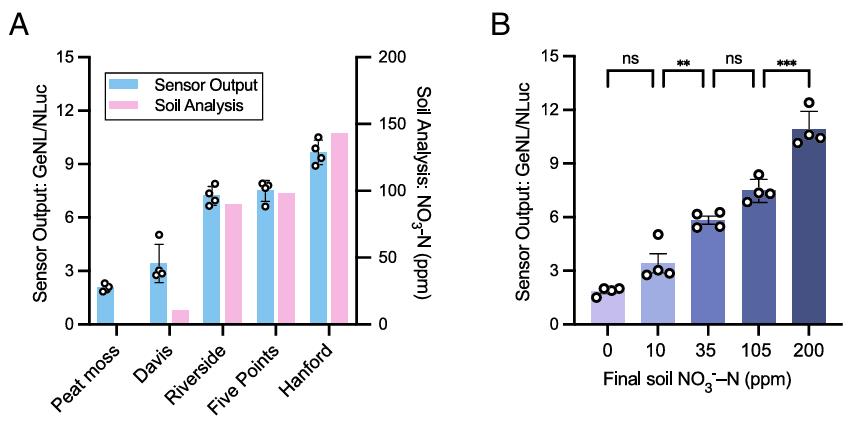
Figure 1. Sentinel plant output closely tracks analytically measured nitrate levels across diverse agricultural soils and incremental nitrate amendments (Li, et al., 2026).
A second major application is monitoring nitrogen transformations carried out by soil and synthetic microbial communities. Nitrogen fixation, nitrification, and denitrification are microbial processes that determine how much nitrate ultimately reaches plant roots, yet measuring these fluxes in situ is notoriously difficult. Sentinel plants offer a way to read the final product of these transformations as plant-available nitrate.
The authors assembled a minimal three-member consortium to convert atmospheric nitrogen into plant-accessible nitrate. The engineered diazotroph Azotobacter vinelandii FM2 carries a deletion in the nifL regulatory gene, giving it constitutive nitrogenase activity and ammonium excretion. Two nitrifying bacteria, Nitrosomonas europaea and Nitrobacter winogradskyi, then oxidize ammonium to nitrate. In liquid coculture, the consortium produced approximately 13 mM nitrate by day 7, whereas wild-type A. vinelandii produced negligible nitrate.
When sentinel plants were exposed to these cultures, they reported nitrate only in the FM2-nitrifier coculture, not in ammonium-rich monocultures or negative controls. This confirms that the plant sensor is responding specifically to nitrate, not to ammonium, organic metabolites, or microbial biomass. The output even matched the 10 mM nitrate positive control, demonstrating quantitative behavior in the presence of active microbes. Such experiments bridge plant microbiome research and agricultural synthetic biology, providing a living readout of microbial activity that matters to plant nutrition.
To move closer to realistic application, the consortium was tested in peat moss, a low-nitrogen model soil. Pots were inoculated with engineered FM2, wild-type A. vinelandii, heat-killed FM2, or Bacillus subtilis as a nondiazotrophic control. Nitrifying bacteria were added to all pots on day 7, and nitrogen dynamics were monitored over 13 days.
The engineered FM2-nitrifier combination accumulated approximately 45 ppm nitrate by day 13, roughly fourfold more than the wild-type Azotobacter treatment and far above the controls. Sentinel plants introduced into the peat moss mirrored these chemical measurements, producing strong signals in FM2 pots and remaining near baseline in control pots. This direct, in-situ agreement between plant reporter output and analytical nitrate assays shows that sentinel plants can track microbial nitrogen transformations as they happen in a soil-like matrix.
Beyond monitoring, the consortium functioned as a biological fertilizer. Wild-type Arabidopsis seedlings grown in FM2-nitrifier peat moss reached a fresh weight of 15 mg, compared with 1.5 mg in the wild-type Azotobacter treatment. Tissue nitrate accumulation was also significantly higher. These results demonstrate that a designed diazotroph-nitrifier community can increase plant-available nitrate, tissue nitrogen uptake, and biomass. The platform therefore accelerates the design-build-test cycle for synthetic crop microbiomes and strategies that reduce chemical fertilizer use.
Although the current sentinel plants require exogenous luciferase substrate, the authors outline clear paths toward autonomous readouts. Bioluminescent systems that recycle their own substrate, pigment-based reporters such as RUBY, and UV-excitable fluorescent proteins could all eliminate the need for chemical application and enable camera- or drone-based imaging. Faster, destabilized reporters could also improve temporal resolution, allowing the platform to capture sub-day fluctuations rather than the multi-day integration window of the current transcriptional reporter.
The broader significance lies in modularity. The design couples a synthetic promoter to a ratiometric reporter, a framework that could be adapted to detect phosphate, potassium, metabolites, or stress signals. Coupled with regulatory circuits, sentinel plants could eventually evolve from passive reporters into responsive crops that adjust root architecture, nitrogen-uptake gene expression, or growth rate based on real-time nutrient status. These possibilities connect to symbiotic nitrogen fixation, nitrogen-fixing enzymes in plants, and ongoing efforts to engineer nutrient-use efficiency.
Sentinel plants represent a conceptual shift in how we monitor nitrogen in agroecosystems. By converting the plant's own nitrate-sensing pathway into a quantitative optical output, the platform reports the nitrogen that plants actually access rather than the nitrogen present in an extracted sample. The sensor performs robustly across controlled media, diverse agricultural soils, and synthetic microbial consortia, and it can be used to screen environmental conditions that influence microbial nitrogen fixation. As rhizosphere microorganisms and crop genetics continue to converge, plant-integrated biosensors will likely become essential tools for precision nutrient management and sustainable agriculture.
Get Latest Lifeasible News and Updates Directly to Your Inbox