Legumes play a vital role in sustainable agriculture through their unique ability to form symbiotic relationships with soil bacteria called rhizobia. These bacteria colonize the roots of leguminous plants, forming specialized structures known as nodules where they convert atmospheric nitrogen into ammonia—a form of nitrogen that plants can use for growth. This process, called symbiotic nitrogen fixation (SNF), reduces the need for synthetic fertilizers and contributes significantly to ecosystem sustainability.
Soybean (Glycine max), one of the most economically important legume crops worldwide, relies heavily on SNF to maintain productivity. However, the mechanisms that regulate nodulation—the formation of nitrogen-fixing nodules—remain incompletely understood. While plants have evolved restrictive mechanisms to prevent excessive nodulation, such as the autoregulation of nodulation (AON) pathway, they also need to actively promote nodulation to ensure sufficient nitrogen supply for growth.
Understanding these regulatory mechanisms is crucial for improving soybean yields, particularly under nitrogen-limited conditions. Researchers at Purdue University have made a groundbreaking discovery that sheds light on this complex regulatory network, uncovering a long-distance signaling loop that actively promotes rhizobial infection and nodulation in Glycine max. This research demonstrates the power of integrating insights from transcriptome analysis and gene function analysis to unravel complex biological processes.
Legumes employ two primary strategies to control nodule numbers: the autoregulation of nodulation (AON) under low nitrogen conditions and nitrogen regulation of nodulation (NON). AON acts as a negative feedback mechanism that restricts nodule formation once a sufficient number of nodules have been established.
In AON, rhizobia stimulate legume roots to produce CLE (CLAVATA3/EMBRYO SURROUNDING REGION-related) peptides, which are transported to shoots to repress the production of miR2111 microRNAs. Reduced miR2111 levels in roots lead to increased expression of symbiosis suppressors called TOO MUCH LOVE (TML) proteins, which inhibit further nodule formation. This inhibitory mechanism ensures that plants do not expend excessive energy on nodule formation.
However, AON-mediated repression of rhizobial infection is not detectable until approximately 2 to 5 days post-inoculation, creating a window during which plants maintain a susceptible state for initial infection. The research team discovered that Glycine max employs an additional, complementary mechanism to actively promote rhizobial infection during this critical early period—a long-distance signaling loop that operates independently of the AON inhibitory pathway.
In a recent study published in PNAS, researchers led by Jianxin Ma identified a systemic regulatory mechanism through which Glycine max promotes rhizobial infection. The study reveals a sophisticated signaling pathway that involves three key components:
This signaling cascade creates a long-distance regulatory loop: When Glycine max roots are inoculated with rhizobia, the bacteria trigger the production of GmCEP7 in the roots. This peptide is then transported from the roots to the shoots, where it suppresses the biogenesis of miR4416-5p—a mobile microRNA that normally travels from shoots to roots. With reduced miR4416-5p levels in the roots, the expression of GmLe3 is enhanced, which in turn promotes rhizobial infection and nodule formation.
Unlike the AON pathway, which functions as a negative feedback mechanism to restrict nodulation, the GmCEP7-miR4416-5p-GmLe3 loop acts as a positive regulatory mechanism that actively promotes rhizobial infection. Together, these complementary mechanisms allow Glycine max to balance the benefits of symbiotic nitrogen fixation with the plant's growth and metabolic demands.
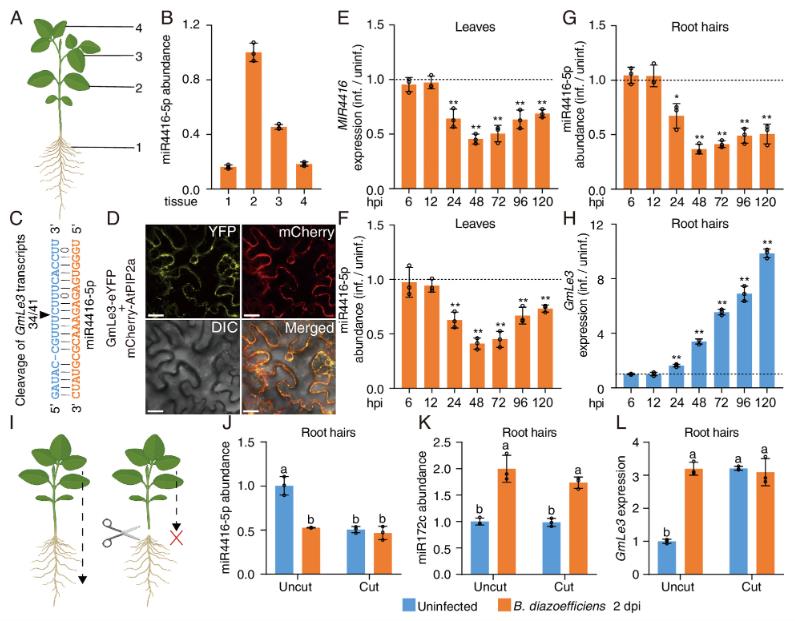
Figure 1. Shoot-derived miR4416-5p regulates GmLe3 expression in roots. (Duan, et al. 2026)
The regulatory mechanism operates through several carefully coordinated steps, each essential for effective nodulation:
When rhizobia come into contact with Glycine max roots, they induce the expression of GmCEP7 precursor genes in root tissues. This response occurs rapidly, as early as 6 hours post-inoculation (hpi), demonstrating the immediate activation of this signaling pathway upon rhizobial recognition.
Once produced, the GmCEP7 peptide is transported from the roots to the shoots through the plant's vascular system. Using stable-isotope-labeled GmCEP7, the researchers were able to directly detect the peptide in leaf tissues after application to roots, confirming its long-distance mobility.
In the shoots, GmCEP7 acts to suppress the production of miR4416-5p—a microRNA that is normally expressed at high levels in leaves. This suppression occurs through the downregulation of MIR4416, the precursor gene that encodes miR4416-5p. As a result, less miR4416-5p is available to be transported from shoots to roots.
miR4416-5p functions as a posttranscriptional regulator that targets and suppresses GmLe3 expression in root hairs. When miR4416-5p levels decrease due to GmCEP7-mediated suppression, GmLe3 expression is released from this inhibition, allowing the lectin protein to accumulate in root hairs.
GmLe3 is a legume lectin protein localized at the plasma membrane of root hair cells. It plays a critical role in promoting early stages of rhizobial infection, including root hair curling and infection thread formation. With increased GmLe3 expression, Glycine max plants become more susceptible to rhizobial colonization, leading to enhanced nodule formation. This finding highlights the potential for gene overexpression strategies to boost nodulation efficiency.
The researchers employed multiple experimental approaches to validate the GmCEP7-miR4416-5p-GmLe3 regulatory mechanism, including transgenic manipulation and grafting experiments:
These findings collectively demonstrate that manipulating the GmCEP7-miR4416-5p-GmLe3 pathway—whether by silencing the microRNA, overexpressing its target gene, or increasing expression of the peptide precursor—can enhance nodulation and improve plant productivity under nutrient-limited conditions. Such targeted genetic modifications could be achieved through advanced techniques like CRISPR/Cas9 genome editing.
Comparative genomic analysis revealed that the miR4416-5p-mediated regulatory module is absent in model legumes Medicago truncatula and Lotus japonicus, but appears to be conserved in economically important legume crops including common bean (Phaseolus vulgaris) and pigeonpea (Cajanus cajan). This suggests that the GmCEP7-miR4416-5p-GmLe3 regulatory loop represents an evolutionary innovation in nodulation control that arose after the divergence between crop legumes and model species.
While Medicago truncatula also utilizes CEP7 peptides to promote nodulation, it appears to employ a different downstream regulatory mechanism. This highlights the importance of integrating insights from both model legumes and crop species to better understand the regulatory mechanisms underlying nodulation and their evolutionary innovation.
The discovery of the GmCEP7-miR4416-5p-GmLe3 regulatory loop has significant implications for improving legume crop productivity and advancing sustainable agriculture:
Field trials conducted by the research team demonstrated that manipulating this pathway can significantly improve agronomic traits including plant height, branch number, pod number, and seed number per plant—key components of crop yield. These results suggest that the GmCEP7-miR4416-5p-GmLe3 module represents a promising target for plant breeding programs aimed at developing more productive legume varieties.
This groundbreaking study unravels a sophisticated long-distance signaling loop that actively promotes nodulation in Glycine max. The GmCEP7-miR4416-5p-GmLe3 regulatory pathway represents a remarkable example of how plants coordinate root and shoot activities to optimize symbiotic relationships with rhizobia.
Critically, this pathway acts as a positive regulatory mechanism that complements the well-known AON inhibitory pathway. While AON restricts excessive nodulation through negative feedback, the GmCEP7-miR4416-5p-GmLe3 loop actively promotes rhizobial infection during the early stages of symbiosis. Together, these complementary mechanisms allow Glycine max to maintain an optimal level of nodulation that balances the benefits of SNF with the plant's metabolic costs.
By understanding how root-derived signals communicate with shoot-derived regulators to control gene expression in root hairs, researchers have uncovered a key mechanism that balances the benefits of symbiotic nitrogen fixation with the plant's growth demands. The findings not only advance our understanding of legume biology but also provide a roadmap for developing strategies to improve legume crop productivity under nitrogen-limited conditions.
For researchers interested in applying these insights to their own work, particularly those studying soybean transformation or exploring gene function analysis in legumes, this study offers valuable tools and knowledge for advancing sustainable agriculture.
Get Latest Lifeasible News and Updates Directly to Your Inbox


A Supergene for Mirror-Image Flowers in Wachendorfia
July 31, 2026
Sentinel Plants Quantify Bioavailable Nitrate
July 24, 2026