Left-right asymmetry is one of the most intriguing problems in developmental biology. In animals, the best-understood examples range from the asymmetric placement of internal organs in vertebrates to the direction of shell coiling in snails. Plants, however, present a rare and beautiful natural case: the mirror-image flower. In certain species, the style is deflected either to the left or to the right of the flower's midline, and the opposing stamen typically bends to the opposite side. Because the female and male organs are placed on reciprocal sides, a pollinator picks up pollen on one flank of its body and deposits it on the matching stigma of a flower of the opposite form. This arrangement limits self-fertilization and promotes efficient cross-pollination, making floral handedness a trait with clear ecological value.
Most enantiostylous (mirror-image-flowered) species are "monomorphic," producing both left- and right-styled flowers on the same individual. A smaller number are "dimorphic," with genetically fixed left-styled (L-morph) and right-styled (R-morph) plants. The South African endemic genera Wachendorfia and Barberetta—commonly called butterfly lilies—belong to this genetically determined camp. Their populations are typically made up of roughly equal numbers of L- and R-morphs, which hints at a single, simply inherited locus under frequency-dependent selection. Understanding how these flowers break left-right symmetry therefore speaks directly to broader questions in crop breeding and the engineering of reproductive traits in crops.
To see how handedness arises, the authors dissected unopened Wachendorfia paniculata buds of increasing length and tracked the alignment of the style and the opposing stamen with the flower midline. In buds shorter than 12 mm the style was still straight; deflection began between 12 and 15 mm and reached its maximum in open flowers. Stamen deflection followed the same logic but became obvious only in the latest stages. Time-lapse videos of cultured buds revealed that the style tip often follows a spiral rather than a simple arc, suggesting that deflection involves both bending and rotation.
Closer inspection of the style epidermis showed that cell files at the base are twisted into a right-handed helix in R-morph styles and a left-handed helix in L-morph styles, while the stamen filaments carry the opposite twist. This intrinsic chirality, however, is only half the story. When buds were cultured rotated by 180°, their styles still deflected to the same absolute side of the world—meaning the flower orients itself with respect to an external reference, gravity, rather than to its own internal dorsoventral axis. Culturing entire inflorescences upside-down produced the same effect: most flowers opened with their styles on the opposite side from normal. By contrast, buds grown on a clinostat (constant rotation that removes a stable gravity cue) developed nearly straight styles. Together, these results show that macroscopic deflection comes from an intrinsic chirality combined with a plant physiology analysis-level gravitropic response: stronger cell expansion on the lower side of the organ.
A simple biomechanical model confirmed the logic. A column built from stacked segments only bends out of the flower's midline when twisting and gravity-driven differential elongation act together; twist alone yields a straight column, and unequal growth alone merely bends the organ upward. Interestingly, the authors found no evidence that helical cortical microtubules drive the twist, as seen in many Arabidopsis twisting mutants. Instead, the chirality appears to reside in the tissue itself—likely in the arrangement of cellulose microfibrils and pectin in the cell wall—because drying the styles dramatically exaggerated their coiling in the same handedness as the living twist.
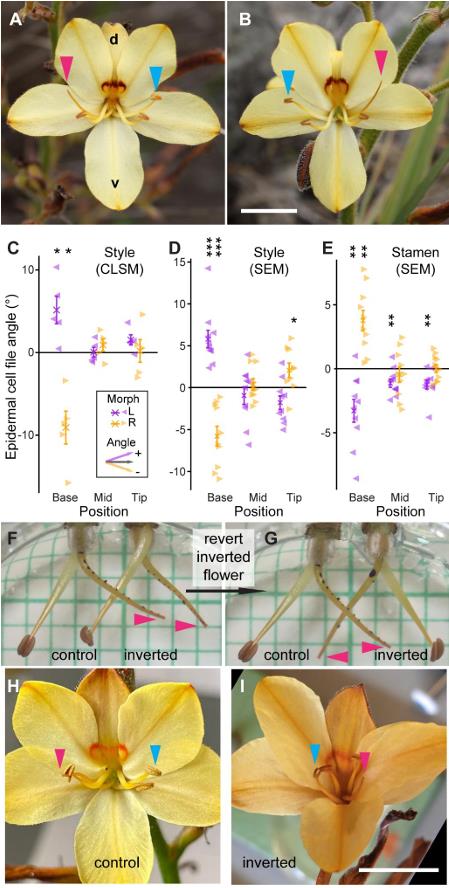
Figure 1. Styles of Wachendorfia paniculata deflect to opposite sides in L- and R-morph flowers and reorient relative to gravity rather than to the flower's internal axes. (Xue, et al. 2026)
The near 1:1 ratio of morphs pointed to a single Mendelian locus. To find it, the team sequenced pooled DNA from 110 L-morph and 110 R-morph individuals from one population and searched for sequences unique to each morph. This surfaced an Arabidopsis-like YUCCA (YUC) gene present only in R-morphs. High-quality PacBio genome assemblies of W. paniculata, W. thyrsiflora, and Barberetta aurea then revealed a hemizygous region of roughly 100–200 kb: in L-morph pools this segment had essentially zero sequence coverage, while in R-morph pools it was covered at about half the genome-wide average. PCR genotyping of all 220 individuals confirmed the rule—YUC-R was present in every one of the 110 R-morph plants and absent from every L-morph plant. The authors named this extra chromosomal segment the R locus.
Annotation, guided by transcriptome data, showed that the R locus carries two conserved, transcribed genes: YUC-R and a microRNA gene, MIR156-R, which produces miR156-5p. (A third, non-coding gene, X1, is present in Wachendorfia but was not detected in the B. aurea R locus.) Because the R locus is hemizygous—R-morphs carry one chromosome with the extra block and L-morphs carry two copies of the chromosome lacking it—the architecture is strikingly similar to the supergenes that control other floral polymorphisms such as heterostyly. This makes plant genetic engineering of handedness a tractable, if challenging, future goal.
The elegance of the system lies in how one supergene controls two organs in opposite directions. RNA sequencing of dissected styles and stamen filaments told the story. YUC-R was expressed specifically in the stamen filaments of mid- and late-stage R-morph buds, while MIR156-R was expressed specifically in the styles of those same buds. YUC enzymes catalyze the rate-limiting step of auxin biosynthesis from tryptophan, and indeed the opposing stamens of R-morph buds contained significantly more indole-3-acetic acid (IAA) than those of L-morph buds. The authors therefore concluded that YUC-R drives leftward stamen deflection by raising auxin levels, an effect visible as enrichment of auxin-related (Aux/IAA) genes among the differentially expressed transcripts. Tools for plant hormone analysis are thus central to dissecting such mechanisms.
For the style, MIR156-R is the more likely causal gene. Small-RNA sequencing detected the R-locus-specific miR156-R-3p only in R-morph styles, and overexpression of the Wachendorfia and Barberetta MIR156-R genes in Arabidopsis thaliana recapitulated the classic miR156 overexpression phenotype (extended juvenile phase, more and rounder leaves), proving the precursor is processed into functional miR156-5p. In the style, miR156-5p appears to act mainly by translational repression rather than by slicing its SPL targets, and R-morph styles showed enrichment of ethylene-response (ERF) transcription-factor genes. This two-gene arrangement—YUC-R bending the stamen left, MIR156-R bending the style right—ensures the two organs point in opposite directions, which is exactly what makes reciprocal pollen placement work. The underlying transcriptome analysis and validation in Arabidopsis also illustrate how gene overexpression in plants and Arabidopsis thaliana transformation remain indispensable for assigning gene function in non-model species.
If the two handedness genes can be lost independently, the mirror-image symmetry should break down—and in nature it does. Surveying many populations, the authors found rare "homostylous" plants in which the style and the normally opposing stamen sit on the same side of the midline. Whole-genome sequencing of these mutants showed a clean logic: right-homostylous plants carried deletions of YUC-R (with MIR156-R intact), whereas left-homostylous plants carried deletions of MIR156-R and X1 (with YUC-R intact). The mutations co-segregated with the phenotype and arose independently in different regions. Because both sexual organs now occupy the same side, homostyly should favor self-pollination and may provide reproductive assurance where pollinators are scarce. This natural gene function analysis by deletion neatly confirms that separate genes within one supergene control style and stamen orientation.
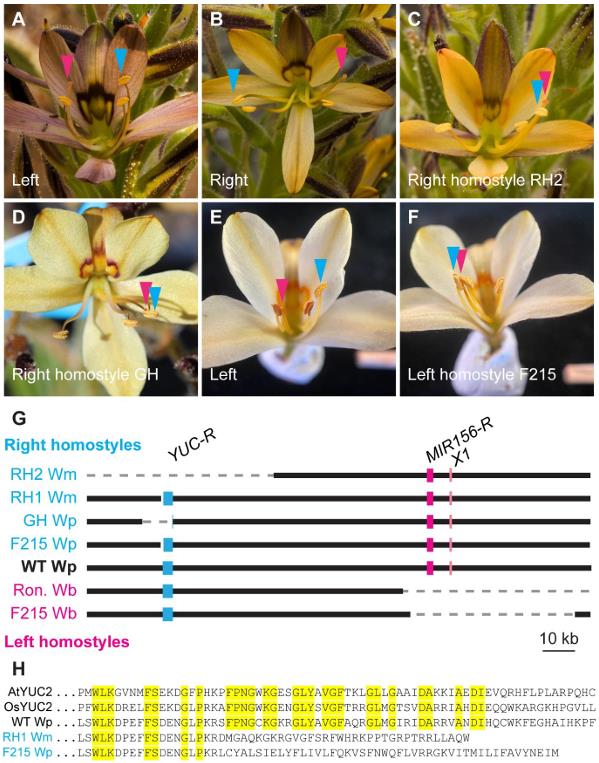
Figure 2. Mutations of YUC-R or MIR156-R/X1 result in right or left homostyles. (Xue, et al. 2026)
How did such a supergene arise? Dimorphic enantiostyly is thought to have evolved from monomorphic enantiostyly, as still seen in the close relative Dilatris ixioides. Phylogenetic and synteny analyses indicate that the YUC-R gene originated from a duplication that occurred after Dilatris split from the Wachendorfia/Barberetta clade, followed by a large segmental duplication that brought YUC-R and MIR156-R together and neofunctionalized them for handedness control. As expected for a hemizygous region, YUC-R shows a much higher dN/dS ratio (about 0.55) than its diploid paralog (about 0.16), consistent with weaker purifying selection. The long-term maintenance of the polymorphism, together with the ~1:1 morph ratio, fits a model of negative frequency-dependent selection imposed by pollinators, who preferentially transfer pollen between the two morphs. Looking ahead, the ability to CRISPR-based genome editing of such supergenes could let researchers test these evolutionary hypotheses directly.
This work resolves a 140-year-old puzzle about some of the most visually striking flowers in the plant kingdom. It shows that left-right asymmetry in plants can be defined not by internal axes, as in vertebrates, but by an external input—gravity—combined with a genetically encoded intrinsic chirality. The R-locus supergene is a compact illustration of how a small number of linked, co-inherited genes can coordinate multiple organs into a single adaptive phenotype, and how that phenotype can be lost in a single mutational step. Beyond its fascination for evolutionary and developmental biologists, the study offers a clear roadmap for anyone interested in the genetic control of reproductive architecture, the role of auxin and microRNAs in organ positioning, and the broader principles by which supergenes generate complex, ecologically important polymorphisms in nature.
The mirror-image flowers of Wachendorfia are built by a hemizygous supergene that flips an intrinsic tissue chirality and links it to a gravitropic growth response. With two causal genes—YUC-R for the stamen and MIR156-R for the style—the R locus produces coordinated left and right organ placement that promotes cross-pollination, while naturally occurring deletions reveal how the same machinery can collapse into selfing. It is a compelling example of how a handful of genes, inherited together, can sculpt one of nature's most elegant symmetries.
Get Latest Lifeasible News and Updates Directly to Your Inbox