Marine eustigmatophyte algae such as Nannochloropsis and Microchloropsis are attractive cell factories. They grow fast, accumulate up to 60% of dry weight as lipids including valuable omega-3 fatty acids, and accumulate carotenoids, including ketocarotenoids such as canthaxanthin and astaxanthin, in a specialized red body. Realizing that potential through genetic engineering of microalgae depends on one unglamorous but essential component: a reliable selectable marker. Without a way to prevent growth of untransformed cells while letting engineered ones survive, selection leaves background colonies and false positives. Existing markers for these algae, based on resistance to hygromycin, Zeocin, blasticidin, G418, or nourseothricin, work inconsistently: hygromycin B and G418 selection has been reported to lose efficacy under high-salinity conditions, Zeocin is mutagenic, and the remaining agents are constrained by intrinsic resistance or background growth. A study in The Plant Journal introduces a promising alternative built around the antibiotic sulfadiazine.
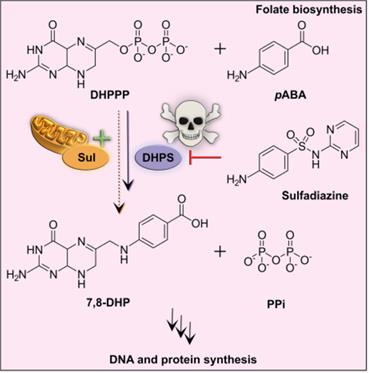
Sulfadiazine blocks dihydropteroate synthase (DHPS), an enzyme in the folate biosynthesis pathway. Folate carries one-carbon units needed for making nucleotides and amino acids, so disrupting the pathway is lethal. The bacterial sul1 gene encodes a sulfadiazine-resistant DHPS (called Sul) that restores folate production even when the drug is present. Expressing sul1 in the alga therefore confers survival on sulfadiazine plates. The critical design choice was subcellular localization. In plants, Sul is usually sent to the chloroplast, but in these algae the native DHPS homologs are mitochondrial, so the authors fused Sul to a mitochondrial targeting peptide. Only mitochondrial-targeted Sul supported robust recovery of transformants; cytosolic constructs gave no colonies, and chloroplast-targeted constructs produced almost none. A shortened mitochondrial peptide (sMTP) worked best, giving colony counts comparable to Zeocin in M. gaditana and far exceeding Sh ble in N. oceanica.
The team first mapped the lethal dose by plating four species on increasing sulfadiazine concentrations. Growth was essentially abolished at 300 µg mL−1 and above, and they adopted 500 µg mL−1 as the standard to suppress rare escapees. At that concentration, wild-type cells failed to grow while sMTP-Sul lines grew comparably to unselected controls. Crucially, the Sul marker showed no cross-resistance to any of the other common selective agents tested, meaning it can be combined with other markers for gene-stacking without interference. This property matters for engineering microalgae for metabolite production, where multiple pathway genes must be integrated at once.
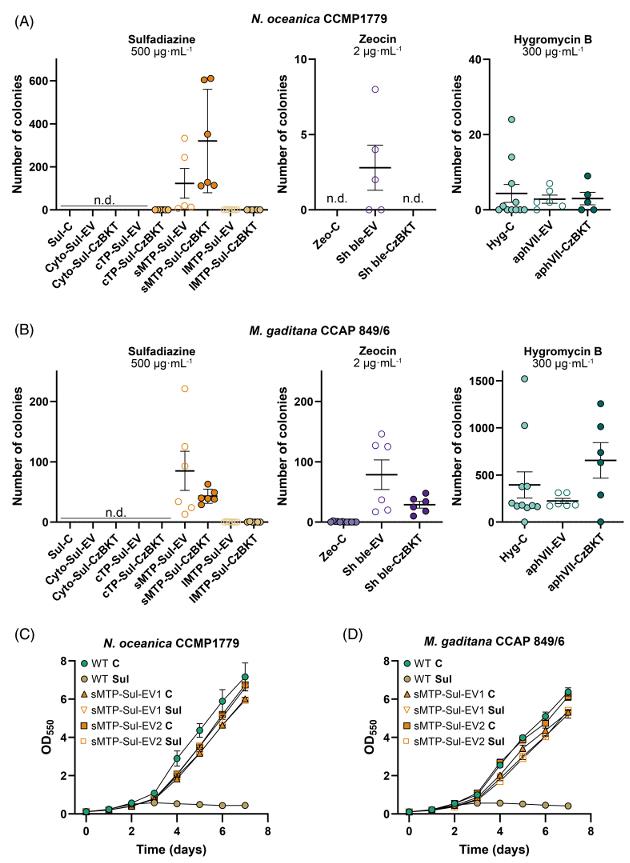
Figure 1. Heterologous sul1 expression confers resistance to sulfadiazine in Nannochloropsis and Microchloropsis. (Straube, et al., 2026).
Side by side with the standard markers, mitochondrial Sul performed consistently well. In Microchloropsis gaditana, Sul and Zeocin gave comparable colony numbers, but in Nannochloropsis oceanica, Sul produced dramatically more transformants than Zeocin, which often yielded none. Hygromycin produced high colony counts in some backgrounds yet also showed concerning background growth in wild-type controls, undermining its reliability. In short, for effective transformation with low false positives, Sul selection was at least as good as and frequently better than the established Zeocin system, with the added benefit of clean, consistent performance across species. Because sulfadiazine itself is inexpensive and the selection is robust, the marker lowers both cost and uncertainty for algal transformation pipelines.
To show the system supports real engineering, the authors expressed the Chromochloris zofingiensis beta-carotene ketolase (CzBKT) under sulfadiazine selection. The transformants turned a distinct brown, accumulated the ketocarotenoids canthaxanthin and adonirubin, and left astaxanthin largely unchanged, matching prior reports of this enzyme's activity in Nannochloropsis. Pigment profiling by mass spectrometry confirmed the new carotenoid peaks. This demonstrates that sulfadiazine selection is not merely a way to keep cells alive but a practical tool for targeted metabolomics of carotenoids and for redirecting algal metabolism toward high-value compounds. When coupled with fatty acid quantification, the platform gives researchers clear readouts of engineering success.
The Sul marker fits naturally into current algal synthetic-biology workflows. Its lack of cross-resistance makes it ideal for intein-mediated stacking strategies that assemble whole pathways behind a single selective agent, an approach already proven in plants and extendable to marine algae as a future application. For groups building expression cassettes, our vector construction capabilities and microalgal omics services, including microalgal transcriptomics, provide the upstream design and downstream validation needed to turn a marker like Sul into a working production strain. The study expands the toolkit precisely where it was thinnest: a dependable, low-background selection system for eustigmatophytes.
The difficulty with existing markers is not accidental but rooted in biochemistry. Marine eustigmatophytes are intrinsically resistant to a long list of common selective agents, including rifampicin, benomyl, nystatin, spectinomycin, ampicillin, and chloramphenicol, so the usable repertoire was already small. Of the markers that work, hygromycin and Zeocin dominate, yet both have drawbacks in seawater. Zeocin inflicts random double-strand breaks and is mutagenic, which is unwelcome in strains meant for clean metabolic engineering, and hygromycin B selection has been reported to lose efficacy under the high salinity that marine species require, letting false positives slip through. Sulfadiazine avoids these pitfalls: it acts on folate biosynthesis, a target the algae cannot easily circumvent, and it remained effective under the marine culture conditions tested. The result is a marker that is both gentler on the genome and stricter against background, a rare combination that explains its strong showing in the head-to-head comparison.
Sul is most valuable when pathways—not single genes—are being engineered. Producing a high-value compound often means stacking several genes, and transformation efficiency typically falls as construct size grows. Because Sul shows no cross-resistance to the other five common agents, it can in principle be paired with them to select multiple cassettes in one cell, or combined with intein-split markers that let a single selective agent validate several integrated expression units. That capability matters for algae bred to make carotenoids, omega-3 oils, or recombinant proteins, where reconstructing a pathway can require four or more transgenes. A clean, non-cross-resistant marker therefore does more than improve single-gene transformation; it lowers the barrier to the multigene assemblies that real biomanufacturing demands. For teams moving from proof-of-concept to production strains, that infrastructure advantage is the marker's lasting contribution, turning a persistent bottleneck into a routine step.
The Sul marker arrives as algal biotechnology scales from lab curiosity to industrial interest. A selection system that is inexpensive, robust, and free of cross-resistance removes a persistent, often overlooked bottleneck that has slowed strain construction for years. With Sul in hand, teams can assemble multigene pathways for carotenoids, omega-3 oils, or recombinant proteins without fighting background colonies or mutagenic agents. Coupled to improving genome-editing tools for algae, the marker helps close the gap between designing a pathway on paper and implementing it in culture. For a field where strain engineering has often been the rate-limiting step, that is a practical advance over existing options. If adopted broadly, the marker could help engineered algae compete with established microbial and plant cell platforms for selected high-value compounds.
Mitochondrially targeted bacterial Sul delivers a high-efficiency, low-background, and robust selectable marker for Nannochloropsis and Microchloropsis, outperforming the hygromycin and Zeocin markers that have dominated the field. By exploiting the algae's own mitochondrial folate enzymes and a shortened targeting peptide, the method yields clean transformants at 500 µg mL−1 of sulfadiazine and supports heterologous production of ketocarotenoids. For anyone pursuing genetic engineering of microalgae, Sul is a welcome, practical upgrade to the transformation toolbox.
Get Latest Lifeasible News and Updates Directly to Your Inbox