Soybean (Glycine max) is a cornerstone oilseed and protein crop, and genetic transformation is the gateway to both gene function studies and molecular breeding. Conventional soybean transformation, however, relies on tissue culture: excising explants, coaxing callus, regenerating shoots on defined media, and selecting transgenic lines over many months. The process is labor-intensive, expensive, slow, and above all genotype-dependent, with only a limited number of amenable varieties routinely used. That bottleneck limits how quickly new traits can be tested in elite germplasm relevant to breeders. A letter in The Innovation reports a straightforward alternative: the cut-dip-budding (CDB) method, which moves genes into soybean under non-sterile, tissue-culture-free conditions by exploiting the plant's own regenerative potential.
CDB was originally developed in other species that can regenerate shoots from wounded tissues without any intermediate culture step. The idea is to deliver Agrobacterium directly to a wounded, in situ explant and then allow the plant to regenerate transgenic shoots directly in soil. For soybean, the authors screened many tissues and found that imbibed seeds with the plumule removed were the key. After imbibition, the seed coat and one cotyledon are removed, both plumules are excised with the tip of a scalpel, and the prepared explant is dipped into a suspension of Agrobacterium tumefaciens carrying the construct of interest. Brief vacuum infiltration helps the bacterium reach wound sites. The explant is then inserted upright into soil and maintained under high humidity for 2 days before being transferred to normal growth conditions, where transgenic shoots regenerate. No sugar-rich sterile medium is used; instead, the infection solution contains a simple buffer of 10 mM MgCl2 and 10 mM MES (pH 5.4), replacing the conventional sugar-containing mix that would promote microbial contamination under non-sterile conditions.
The efficiency of the basic protocol was modest, at approximately 0.42%, but the study's key advance is demonstrating that CDB works in soybean and then improving its efficiency. Because CDB depends on the plant's intrinsic regeneration, the authors tested developmental regulators known to boost shoot formation. Isopentenyl transferase (ipt) gave the strongest effect, and combining ipt with other regulators such as GmWOX5, GmWUSa, GmWUSb, GmGRF3-GIF1, and GmBBM1 pushed transformation higher still. Using the ipt-assisted CDB system, positive transgenic shoots were detected within approximately 2 weeks, and most emerged within 1 month, dramatically shortening the soybean transformation cycle. This speed is a major practical advantage over tissue-culture protocols that can take far longer to reach rooted plants.
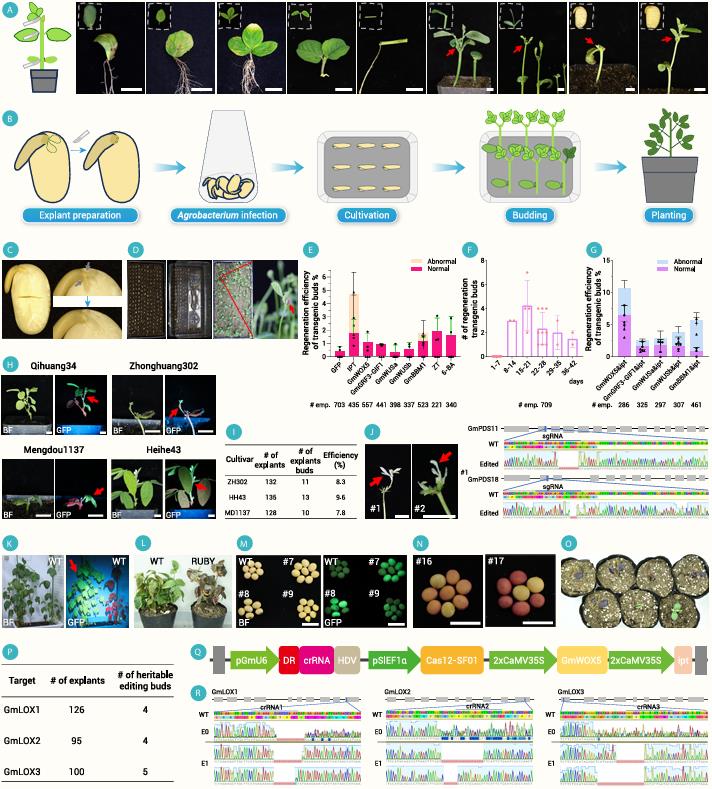
Figure 1. Establishment of a cut-dip-budding method for soybean genetic transformation. (Cao, et al., 2026)
The most encouraging result is that CDB is not confined to a single model variety. Beyond the cultivar Qihuang 34, the method succeeded in Zhonghuang302, Mengdou1137, and Heihe43, the last being a principal cultivar in Northeast China that is recalcitrant to conventional transformation. Average transformation efficiencies were 8.3%, 7.8%, and 9.6% for these three varieties, respectively, demonstrating that the system substantially reduces the long-standing genotype dependency that has constrained soybean biotechnology. Because the workflow runs entirely under non-sterile conditions, needs no complex medium, and involves minimal handling, it is accessible to specialists and non-specialists alike, which should accelerate adoption across labs.
CDB is not limited to transgenesis. When a CRISPR construct targeting the PDS gene was delivered, albino, gene-edited shoots were obtained in the E0 generation, and a Cas12-based construct targeting three lipoxygenase genes (GmLOX1, GmLOX2, GmLOX3) produced edits that were confirmed by sequencing and stably inherited to the next generation. Approximately three-quarters of seedlings from a RUBY-expressing transgenic plant expressed RUBY, further confirming that CDB can generate heritable modifications rather than transient events. This makes CDB a platform for both tissue-culture-free gene editing and gene knockout work, complementing our transgene-free gene editing offerings.
CDB does not replace every existing approach, but it fills a gap that conventional plant genetic transformation leaves open for soybean. Its simplicity lowers the barrier to entry, its non-sterile nature reduces cost and contamination risk, and its genotype flexibility expands the germplasm that can be engineered. For teams weighing investment in plant genetic engineering, CDB is a strong candidate for rapid trait prototyping, especially when combined with the regeneration booster regulators described in the study. As molecular breeding shifts toward faster cycles, methods like this that shorten breeding timelines and widen genotype coverage will become increasingly valuable.
Part of CDB's appeal is operational. Conventional soybean transformation demands laminar-flow hoods, sterile media, and trained technicians, resources that are unavailable to many breeding programs and teaching laboratories. CDB needs a scalpel, a beaker of Agrobacterium suspension, soil, and a growth chamber, without requiring a sterile hood. That lowers both cost and the skill barrier, so a small program can test traits in its own elite material rather than outsourcing to a specialized facility. The non-sterile condition also removes the sugar-containing medium that feeds contaminants, a frequent cause of failure in tissue culture. For institutions building local transformation capacity, such a forgiving method is easier to standardize and teach, which matters as more crops move into the editing era and demand for in-house transformation grows.
The developmental regulators that improve CDB efficiency warrant careful evaluation. ipt gave the largest gain but also produced some abnormal buds, indicating that enhancing regeneration too strongly can perturb normal development. Combining ipt with GmWOX5, GmWUSa, GmWUSb, GmGRF3-GIF1, or GmBBM1 improved both regeneration and transformation, suggesting that combinatorial enhancement can outperform individual regulators. Because some ipt-assisted buds showed developmental abnormalities, the choice and combination of developmental regulators should be optimized according to the specific application. When the goal is to generate plants for further breeding or field evaluation, combinations that produce phenotypically normal shoots may be preferable to ipt alone. Selecting the appropriate booster for the intended application is what turns CDB into a dependable transformation method.
CDB's arrival is well timed for soybean, where trait discovery has outpaced the capacity to test edits in agronomically relevant lines. By eliminating the need for sterile plant tissue culture, the method has the potential to reduce the cost per transgenic event and make the technology accessible to smaller laboratories. The next steps are obvious: extend the developmental-regulator toolkit, test more elite cultivars, and combine CDB with base or prime editors, although achieving transgene-free outcomes would require appropriate DNA-free or transient delivery strategies. If those combinations mature, soybean engineering could shift from a specialist service to a routine bench procedure, much as PCR became universal decades ago. The genotype barrier that defined the crop's biotechnology is finally starting to look surmountable rather than permanent. Wider adoption will depend on sharing optimized protocols and regulator constructs openly across the soybean research community.
The cut-dip-budding method shows that soybean genetic transformation can be achieved without tissue culture, under non-sterile conditions, and across genotypes that resist conventional protocols. By pairing a minimal cut-dip-budding step with developmental regulators such as ipt, researchers can obtain transgenic and edited soybean in weeks rather than months, with stable inheritance confirmed through the next generation. For a crop long limited by recalcitrance, CDB is a pragmatic advance that brings soybean transformation within reach of far more laboratories and breeding programs.
Get Latest Lifeasible News and Updates Directly to Your Inbox