Wheat is one of the world's most important staple crops, yet its genetic improvement through transgenic and gene-editing approaches has long been hampered by a frustrating reality: some varieties transform easily, while elite cultivars that breeders actually want to improve stubbornly refuse to regenerate. Regeneration, the process by which a piece of tissue rebuilds a whole plant, sits at the heart of almost all Triticum aestivum transformation workflows. If callus cannot produce shoots, no transgenic wheat results. A study published in Cell Reports now explains why this divergence exists at the level of chromatin and transcription, and identifies a regulatory module that can rescue poor regenerators.
The authors compared two wheat genotypes with opposite behaviors. Fielder is highly regenerable and has become a model for transformation, whereas JM22 is an elite-like line that barely regenerates. Using time-course RNA sequencing and ATAC-seq to map chromatin accessibility, they tracked how the two genotypes rewire their gene networks after transformation is induced. The picture that emerged was stark. In Fielder, the period between three and six days after induction saw massive transcriptional reprogramming and chromatin remodeling, switching on morphogenic regulators such as TaSCR, TaWOX5, and TaLBD17. JM22, by contrast, showed minimal chromatin change and almost no activation of these regeneration genes, leaving it stuck in a non-responsive state.
By building transcriptional regulatory networks from the accessible chromatin regions, the team found that Fielder's regeneration program was enriched for transcription factor families already known to matter in development, including AP2, Dof, G2-like, and GRAS. Building on a prior Fielder network of 446 core transcription factors, comparative TRN analysis in this study identified TaSCR as a Fielder-specific, highly expressed core regulator that boosts regeneration by turning on meristem-related genes. TaSCR is not acting alone. It cooperates with its downstream target TaLBD17, and together the TaSCR–TaLBD17 cascade promotes the cell fate transitions needed for shoot formation. This module represents a concrete molecular handle on a problem that had previously been described only as vague "genotype dependence."
An important detail is where TaSCR comes from. The study shows that TaSCR is indirectly activated by auxin through the upstream transcription factors TaARF22 and TaGATA15. Auxin and cytokinin are the classic hormones of tissue culture, and here their signaling is linked directly to chromatin opening at regeneration loci. This explains why hormone balance during somatic embryogenesis and plant regeneration is so decisive: it determines whether the chromatin of key regulators becomes accessible at all. In genotypes like JM22, that window never opens, so downstream morphogenic genes stay silent regardless of how much hormone is supplied later.
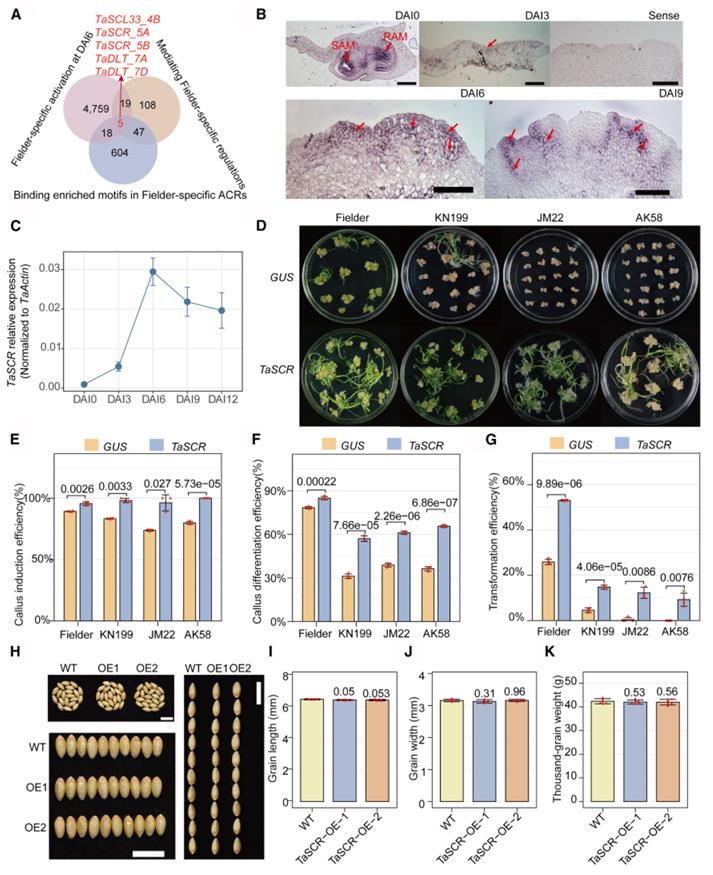
Figure 1. Overexpression of TaSCR improves transformation efficiency across diverse wheat varieties (Bie, et al., 2026).
The decisive test was functional. Overexpressing TaSCR in Fielder raised transformation efficiency from about 26 percent to more than 53 percent. More importantly, the same TaSCR–TaLBD17 module enhanced regeneration and transformation across several diverse wheat genotypes, not just the easy model. In a notably recalcitrant background, transformation reached roughly 9 percent where it had previously been near zero. Because overexpression of a single transcription factor can compensate for an otherwise closed chromatin landscape, the finding offers a practical route to broaden the set of wheat lines that can be engineered. For breeders, this means the gap between a promising elite cultivar and a transformable one may be bridgeable with a developmental regulator rather than years of media optimization.
These insights dovetail with the broader push toward CRISPR-based genome editing in cereals. Editing reagents still need to reach regenerating cells, so any factor that raises regeneration automatically improves editing recovery. The work also illustrates how transcriptome analysis and chromatin profiling can move from descriptive catalogs to predictive tools: measuring accessibility at TaSCR and related loci could one day screen varieties for transformability before a single experiment is run. Combined with gene overexpression strategies, the TaSCR–TaLBD17 cascade is a clear candidate for inclusion in transformation vectors aimed at stubborn genotypes.
The centrality of chromatin accessibility reframes regeneration as a problem of opportunity rather than capability. The genes needed to build a shoot, TaSCR, TaWOX5, TaLBD17 and others, are present in every wheat cell, but in a poor regenerator their regulatory DNA stays closed, so the transcription machinery simply cannot reach them. ATAC-seq makes this visible: open regions mark where the regeneration program is permitted to start, and closed regions mark where it is blocked. This explains why supplying more hormone to a recalcitrant line often fails; the relevant loci are physically inaccessible, not merely uninduced. It also explains why a single transcription factor like TaSCR can be so effective, because once its locus is open and active it can pry open the downstream network needed for shoots. Accessibility is the gate, and the TaSCR-TaLBD17 module is the key that fits it. In JM22 the chromatin barely moved, a molecular snapshot of a line that is biologically capable but locked out.
Beyond the practical fix, the study points toward prediction. Because regeneration competence leaves a chromatin signature, it should be possible to profile candidate varieties before transformation and rank them by how accessible their regeneration loci are. Such a screen would tell a breeding program which elite lines are worth the investment and which need a developmental-regulator rescue from the start. Combined with the increasingly detailed transcriptional regulatory networks now available for wheat, this turns genotype dependence from an unexplained nuisance into a measurable, engineerable trait. The same logic applies to other cereals where regeneration is the limiting step, suggesting that chromatin accessibility could become a routine diagnostic alongside the tissue-culture recipes that laboratories already tune by trial and error. The direction of travel is clear: regeneration is becoming a designed property rather than a lucky accident of genotype, and for teams weighing where to invest, that shift from art to assay is the real headline of the paper.
The practical upshot is that wheat, long a poster child for transformation difficulty, now has a clear molecular handle on its bottleneck. Combining chromatin accessibility profiling with TaSCR or TaLBD17 overexpression offers a two-step route: first diagnose whether a variety's regeneration loci are open, then supply the missing regulator if they are not. As more wheat regulatory networks are mapped, similar modules will likely emerge for other cereals, turning a historically empirical craft into a predictable engineering discipline. For breeding programs, the immediate win is access to elite material that was previously out of reach, accelerating the delivery of edited traits from the laboratory to the field and reducing the monopoly of a few model varieties.
The study reframes wheat regeneration failure as a chromatin accessibility problem with a defined genetic fix. A Fielder-active network centered on TaSCR—which is induced by auxin through TaARF22 and TaGATA15—opens the chromatin needed to launch shoot regeneration, and its downstream partner TaLBD17 carries the signal forward. When this module is supplied to weak regenerators, transformation efficiency climbs across genotypes. For plant genetic transformation programs and crop breeding more broadly, the lesson is that genotype flexibility in wheat is achievable by engineering the regeneration step itself, not by fighting each cultivar's recalcitrance one medium at a time.
Get Latest Lifeasible News and Updates Directly to Your Inbox