CRISPR-Cas systems are widespread among prokaryotes, providing adaptive immunity against invading viruses and plasmids. The system consists of clustered regularly interspaced short palindromic repeats (CRISPRs) and CRISPR-associated (Cas) proteins. While the mechanism of CRISPR-Cas action is well understood, its evolutionary origins have been the subject of intense debate.
One key question has been the origin of RAMPs — a diverse group of proteins associated with CRISPR systems that include Cas1, Cas2, and other accessory proteins. These proteins are thought to play crucial roles in spacer acquisition and CRISPR array maintenance, but their evolutionary history has been unclear. Understanding the origins of these systems could provide valuable insights for improving CRISPR-based genome editing tools and developing novel applications.
Using a structure-guided discovery pipeline, researchers identified a novel group of proteins called VIPR (Virus-Induced PRoteins) systems in phage genomes. These systems are characterized by a conserved protein domain (Vipr) and associated RNAs (vrRNAs), forming a minimal RNA-guided DNA recognition complex.
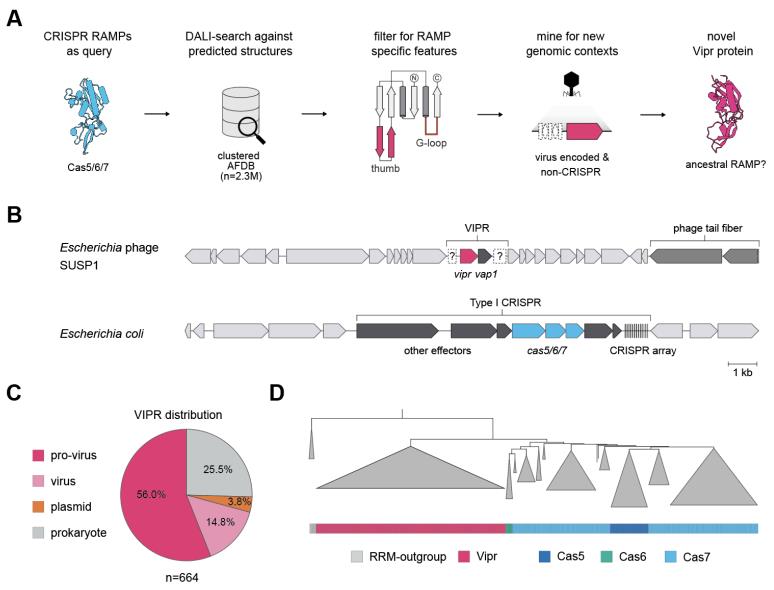
Figure 1. Vipr is a phage-encoded ancestor of CRISPR RAMPs. (A) Structure-guided discovery pipeline. (B) Comparison of a representative VIPR locus (Escherichia phage SUSP1) and a Type I CRISPR locus (E. coli). Question marks denote candidate noncoding RNA (ncRNA) regions. (C) Distribution of VIPR systems across viral and cellular genomes (n = 664). (D) Maximum-likelihood phylogenetic tree of Vipr and CRISPR RAMPs, rooted on an RRM outgroup. (Yoon, et al. 2026)
The researchers determined that Vipr proteins share structural similarities with CRISPR RAMPs, particularly in their RNA-binding domains. Functional studies revealed that VIPR systems can specifically recognize and bind to target DNA sequences guided by their associated vrRNAs, demonstrating a primitive form of RNA-guided DNA recognition. This finding opens new possibilities for engineering compact RNA-guided systems that could complement existing gene knockout technologies.
Analysis of 664 viral and cellular genomes revealed that VIPR systems are widespread in phages, particularly those infecting Enterobacteriaceae. Interestingly, VIPR systems were also found in some bacterial genomes, suggesting horizontal gene transfer from phages to their hosts — a key step in the evolution of CRISPR systems. This discovery highlights the dynamic nature of microbial evolution and the potential for harnessing naturally occurring systems for biotechnological applications.
Based on their findings, the researchers propose a new model for the evolution of CRISPR systems from VIPR ancestors:
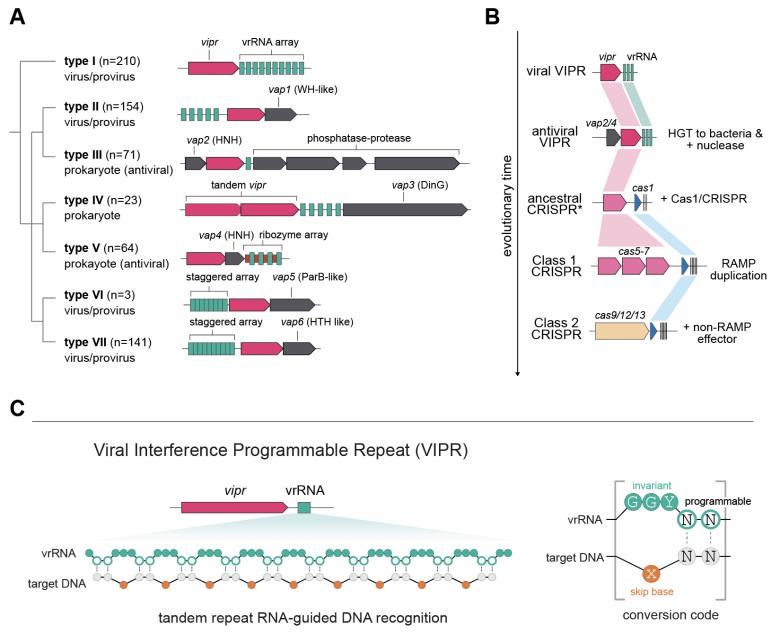
Figure 2. Diverse VIPR systems suggest a new model for CRISPR evolution. (A) Classification of 667 representative VIPR systems into seven types. Simplified Vipr protein phylogeny annotated with type, abundance, and taxonomic distribution (left). Representative locus diagrams for the type (right). Green squares, vrRNAs; magenta, vipr gene; gray, vap genes. (B) Diagram of proposed model for VIPR evolution to CRISPR via horizontal gene transfer (HGT) from virus to prokaryotic host. (*) denotes hypothetical locus. (C) Summary of VIPR RNA-guided DNA recognition mechanism following the 1 nt skip rule. (Yoon, et al. 2026)
A key finding was the identification of a "1 nt skip rule" in VIPR RNA-guided DNA recognition. Unlike CRISPR-Cas systems, which typically recognize a fixed PAM (protospacer adjacent motif), VIPR systems follow a unique recognition mechanism that involves skipping one nucleotide between the guide RNA and target DNA. This suggests that the PAM-dependent recognition mechanism of CRISPR-Cas systems evolved later from the simpler VIPR recognition strategy. Understanding these differences could inform the design of more flexible genome editing tools.
The researchers classified 667 representative VIPR systems into seven distinct types based on their genomic organization and protein phylogeny. Each type is characterized by unique combinations of Vipr proteins, vrRNAs, and accessory proteins (vap genes). This diversity suggests that VIPR systems have undergone extensive evolutionary diversification, providing a rich source of genetic material for the evolution of CRISPR systems. For researchers interested in exploring gene function, this classification provides a valuable framework for understanding the functional diversity of RNA-guided systems.
The discovery of VIPR systems has significant implications for understanding CRISPR evolution and potentially for developing new genome editing tools:
By studying VIPR systems, researchers can gain insights into the early stages of CRISPR evolution, including how RNA-guided DNA recognition mechanisms arose and diversified. This knowledge can inform the development of novel approaches to plant genetic modification and other biotechnological applications.
VIPR systems represent a new class of RNA-guided DNA-binding proteins that could potentially be engineered for genome editing applications. Their compact size and unique recognition mechanism make them attractive candidates for development as novel editing tools, particularly for applications where size constraints are important.
The widespread distribution of VIPR systems in phages suggests they play important roles in phage-host interactions. Understanding these systems could provide insights into how phages manipulate their hosts and how hosts defend themselves, which could have implications for crop protection strategies and disease management.
The discovery of VIPR systems represents a major breakthrough in understanding the evolutionary origins of CRISPR-Cas systems. By identifying Vipr as a phage-encoded ancestor of CRISPR RAMPs, the researchers have provided compelling evidence for a viral origin of CRISPR systems and proposed a detailed model for their evolution.
This work not only sheds light on the evolutionary history of one of the most important biological discoveries of the 21st century but also opens new avenues for research into RNA-guided DNA recognition mechanisms and the development of novel genome editing technologies.
For researchers interested in exploring the evolutionary origins of CRISPR systems or developing new editing tools, this study provides a valuable foundation. Whether you're working on gene functional analysis, plant genetic modification, or crop improvement, understanding the evolutionary history of CRISPR-Cas systems can inform and inspire innovative approaches to genome engineering.
Get Latest Lifeasible News and Updates Directly to Your Inbox